


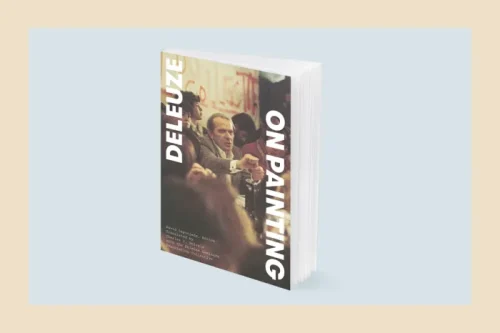
 Prof Eugenie Brinkema explores the philosophical history and effects of Giles Deleuze’s eight essays on paintings, delivered between 1981-2023. For starters, “Philosophy, for Deleuze, is an act of creation: “the art of forming, inventing, and fabricating concepts,” as he words it. When he contended with Bergson, Spinoza, or Leibniz, it was to extract what concepts each thinker had generated.” In bridging philosophy and art, Prof Brinkema explores the history and technique of the mental struggle: “In response to the desire to explore “the possibility that painting has something to offer philosophy,” Deleuze tells a story. In the beginning, there is chaos: this is the pre-pictorial condition of the painting. The painting doesn’t exist yet; anything
 could happen. Then, some “catastrophe” occurs: a generative chaos from which a “diagram” emerges, which will lead to the painting itself, or the “pictorial fact.” Why does painting require a catastrophe? It is due to “the struggle with ghosts that precedes painting”: struggle, thy name is cliché.”
In summary, Philosophy doesn’t work as TL;DR. Read more here…