

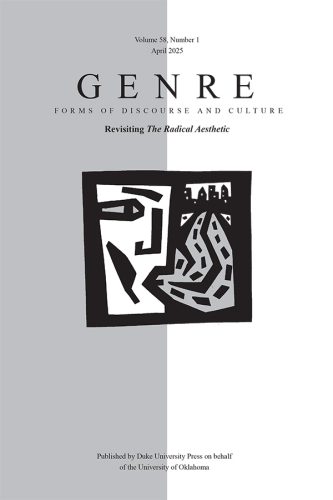
 In the introduction to Genre‘s special issue, Revisiting (Isobel Armstrong’s) The Radical Aesthetic, co-editors Merve Emre and Justin A. Sider comment on Professor Brinkema’s essay:
“We begin with Eugenie Brinkema’s “Isobel&Gillian&Julia&Hélène&Camille &Judith&Eve&me,” a stylish genealogy of the critics who owe an unacknowledged debt to Armstrong. How was it possible to ignore a book that was “almost messianically oriented toward fights” that played out over the next two decades? As Brinkema rehearses key arguments from the affective turn by Sara Ahmed, Teresa Brennan, Sianne Ngai, Marco Abel, Ruth Leys, and even herself, she finds each scholar posing once again Armstrong’s questions without reference to Armstrong’s book. The possible reasons are various: the affective turn’s relative indifference (or even hostility) to textuality and form, the conceptual specificity by which other scholars of affect did return to the aesthetic (as in Brinkema’s own interest in the relation between “form” and “affect”), and the resistance of the aesthetic as such to the reductions of disciplinary procedure and protocol. Yet the central reason for Armstrong’s invisibility, Brinkema argues, involves the book’s most provocative conceptual move—to make feminist theory “essential for a rethinking of the category of the aesthetic.” Through the long list of feminist thinkers who appear in The Radical Aesthetic—Brinkema records them all, a range of reference that is truly stunning—Armstrong implicitly argues, according to the article, that “feminist thought is a thinking of form,” that any truly vital return to the aesthetic will discover in feminist theory the possibility “to think poetically about doxa,” and that feminist theory is likewise continually renewed by a return to the aesthetic, to problems of form and relation. In this respect, Armstrong’s book must remain untimely, as a key contribution to the unfinished philosophical projects of feminism and the aesthetic.”