

Events

Ancient & Medieval Studies Colloquium presents, Dan Smail “Practices of Slavery in Mediterranean Europe, 1250-1500”
March 30 @ 5:15 pm - 7:00 pm
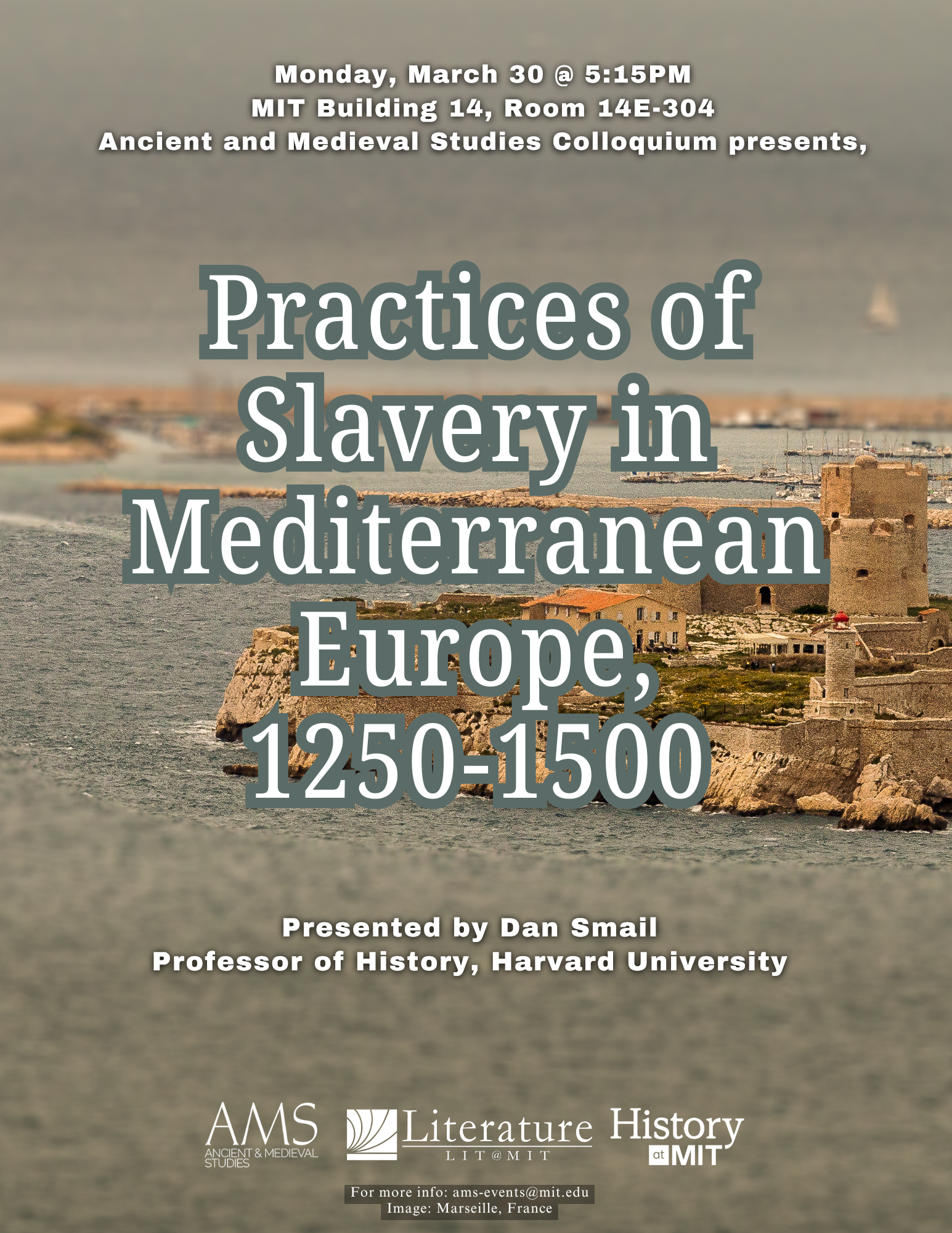 Presented by Daniel Smail
Frank B. Baird Jr. Professor of History
Harvard University
Date: Monday, March 30
Location: Building 14, Room 14E-304 (map)*
*Directions: From the Lewis Music Library stairs, take the third floor of Building 14, through the CMS/W doors. Alternatively, take the elevator to the 3rd floor, navigate to the opposite end of the 3rd floor hallway, and enter through the CMS/W doors.
Abstract: Everywhere in late medieval Mediterranean Europe, it was possible, at least in theory, to purchase and hold an enslaved individual. The traffic in slaves began a noteworthy period of growth in the thirteenth century. In the second half of the fourteenth, the rise of the Black Sea trade led to a significant acceleration. Yet the practice of slavery was never uniform across the region. In some cities, as much as 15 percent of the population may have been enslaved. Elsewhere, the presence of enslaved individuals is scarcely detectable. The significant variation in the degree to which slavery implanted itself in the cities and towns of Mediterranean Europe is a historical phenomenon in search of explanation. Through a survey of practices of slavery in Marseille, a city located in the borderlands of the practice, this lecture seeks to frame a set of questions that could guide research in coming decades.
Bio: Daniel Lord Smail is Frank B. Baird, Jr. professor of history at Harvard University, where he works on the history and anthropology of Mediterranean Europe between 1100 and 1600 and on deep human history. In recent work, he has been using household inventories from the period to understand transformations in material culture. His most recent book is Magdalena Coline: A Life Beyond Mediterranean Slavery (Princeton University Press, 2025).
Literature Section
Massachusetts Institute of Technology
77 Massachusetts Avenue 14N-407
Cambridge, MA 02139
tel: (617) 253-3581
