

Events

- This event has passed.
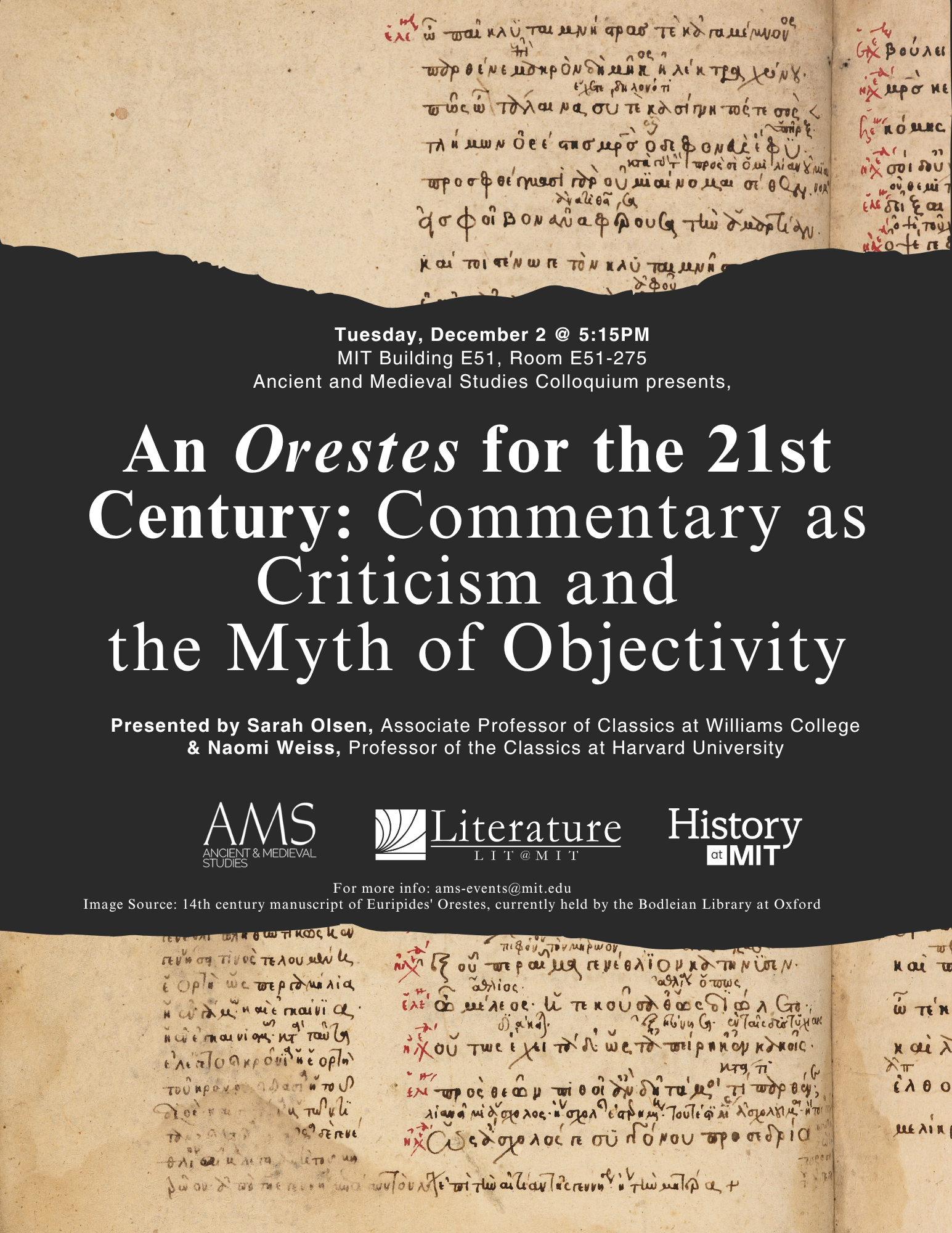
Ancient & Medieval Studies Colloquium presents, Sarah Olsen & Naomi Weiss “An Orestes for the 21st Century: Commentary as Criticism and the Myth of Objectivity”
December 2, 2025 @ 5:15 pm - 6:30 pm
 Presented by:
Sarah Olsen (Associate Professor of Classics at Williams College) and Naomi Weiss (Professor of the Classics at Harvard University)
Euripides’ Orestes, first produced in 408 BCE, was one of the most popular tragedies in the ancient Greek and Byzantine worlds. It is also a play suited to a range of current scholarly and cultural interests, from ancient music to queer reimaginations of antiquity to the construction of race in ancient Greece, while the ways it pushes the boundaries of form and genre look increasingly at home among today’s postmodern and experimental theater. At present, however, work on Orestes is hampered by the absence of a modern English commentary. In this talk, we will discuss our approach to creating such a commentary, as well as broader questions about the purpose, audience, and unexamined assumptions of the commentary as a scholarly genre in the 21st century.
The commentary, a vital resource in the study of any ancient Greek drama, is considered the most traditional and conservative form of scholarship in Classics. It is typically presented as objective, with a single answer for each apparent problem with the text, from confusing syntax to questions about performance. Yet in fact the commentary is a significant scholarly intervention into the text, interpretation, and reception of a particular play—and one that can set the agenda for many years to come. In this talk, we challenge the myth of the commentary’s objectivity by exposing some of the interpretative work that goes into writing one. We focus on three examples from Orestes: the editorial excision of lines; inferences made from the text about performance; and the glossing of unusual words or difficult phrases. We show how these are important sites of interpretation within the commentary genre, and that the questions they raise have especially high stakes for our reception of this extraordinary tragedy.
Naomi Weiss is Professor of the Classics at Harvard University. She is the author of Seeing Theater: The Phenomenology of Classical Greek Drama (2023) and The Music of Tragedy: Performance and Imagination in Euripidean Theater (2018). She has also co-edited Genre in Archaic and Classical Greek Poetry: Theories and Models (2019) and Music and Memory in the Ancient Greek and Roman Worlds (2021), and is the series co-editor for Cambridge Elements in Greek and Roman Drama and Performance.
Sarah Olsen is Associate Professor of Classics at Williams College. She is the author of Solo Dance in Archaic and Classical Greek Literature: Representing the Unruly Body (2021), as well as various articles and book chapters on ancient Greek literature, art, and culture. She has also co-edited Queer Euripides (2023) and Imprints of Dance in Ancient Greece and Rome (2024; Spanish edition 2025).
Sarah Olsen is Associate Professor of Classics at Williams College. She is the author of Solo Dance in Archaic and Classical Greek Literature: Representing the Unruly Body (2021), as well as various articles and book chapters on ancient Greek literature, art, and culture. She has also co-edited Queer Euripides (2023) and Imprints of Dance in Ancient Greece and Rome (2024; Spanish edition 2025).
Literature Section
Massachusetts Institute of Technology
77 Massachusetts Avenue 14N-407
Cambridge, MA 02139
tel: (617) 253-3581
