

Events

- This event has passed.
Global France Seminar presents, Deborah Jenson “During ‘Man’: Caribbean Philosophies of Cognition from Anténor Firmin to Sylvia Wynter”
April 1 @ 5:15 pm - 6:30 pm
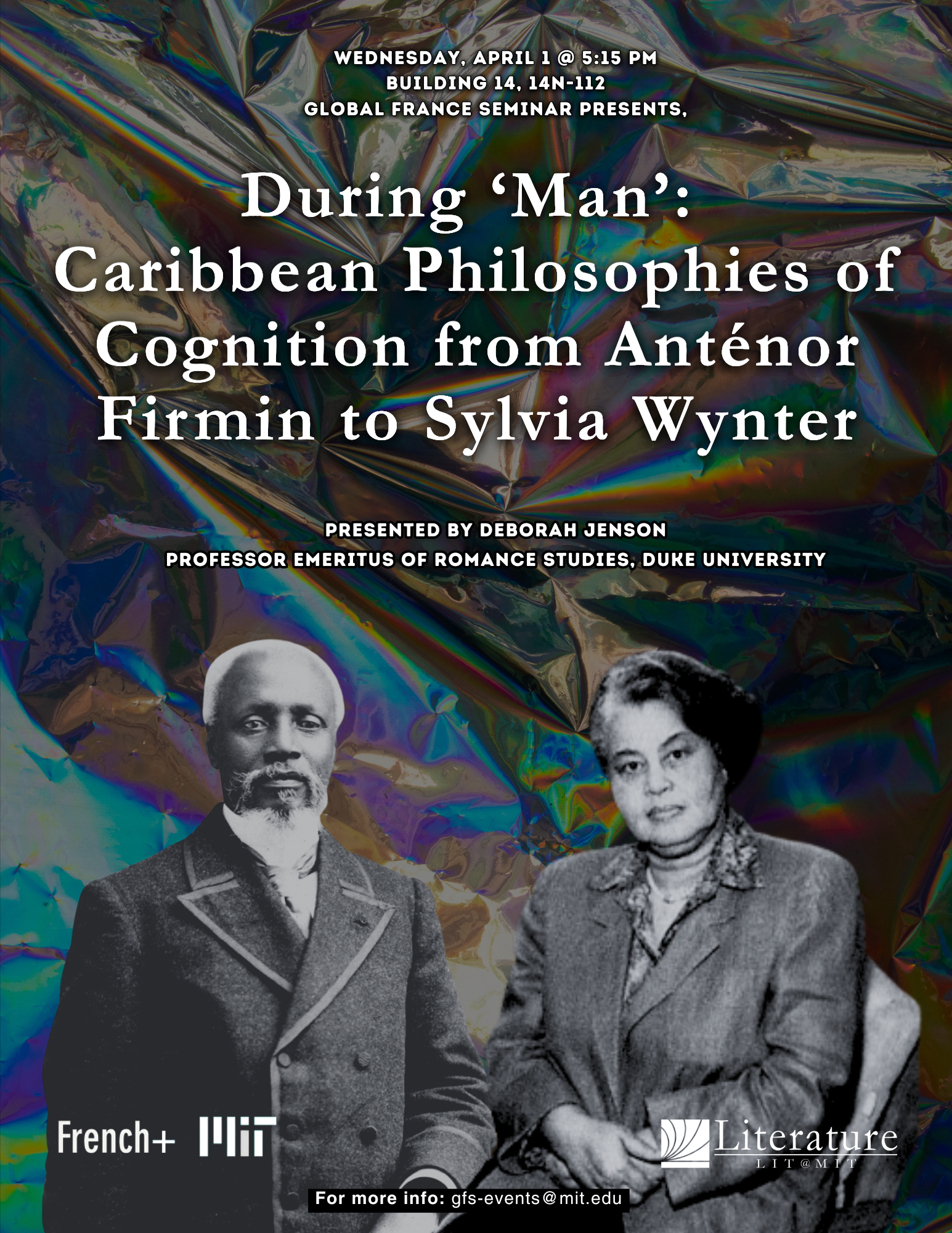 Presented by Deborah Jenson
Professor Emeritus of Romance Studies, Duke University
Abstract: Sylvia Wynter defines a founding “Word of Man” representing man as a “selected being and natural organism” from 1512 onward. Around “Man,” Western Europe founded a tradition of secularized discourse heralding global expansion and plantation colonialism. “Man” for Wynter is an epoch as well as a figure, in whose name connections are forged between empirical scientific methodologies, liberal economies, and racialized identities of “Man-as-liber.” In this paper I present Wynter’s concept of the “autonomy of human cognition,” and of autopoiesis as biological cognition, in the context of a broader Caribbean and Latin American genealogy of freedom within the “Cognitive Charter” of modernity. From the responses of the Haitian thinker Anténor Firmin to the early brain science as presented at the Paris Anthropological Society where he was a member in 1883-84, to the development of cultural or ethno psychiatry in Haiti by Louis Mars, to Wynter’s integration of Chilean theoretical biology into her philosophy, I will present a Caribbean counter-model of cognition, not the Cartesian ego-model of rational consciousness, or what Vidal has called “brainhood,” but an environmental model of human being as praxis, in which, as Varela would later write, “cognition and world are interdependently originated via the living body.”
Bio: Deborah Jenson, Professor Emeritus of Romance Studies at Duke University, finds in the work of Sylvia Wynter an uncanny challenge for her research at the crossroads of modern French and Caribbean (especially Haitian) literature and culture, cognitive studies, and global mental health. She has a current exhibit on Sylvia Wynter, “Noise Up the World: Introducing the Archive of Sylvia Wynter” at the Duke Rubenstein Library, and the article “Ceremonies Lost and Found: Global South Critical Philosophy Against Cognitive Exceptionalism” in PMLA (2022). Her first book, Trauma and Its Representations (Johns Hopkins UP, 2001), engaged with the problems of trauma and social mimesis in literary and cultural legacies of the French Revolution. Her next book, Beyond the Slave Narrative: Manuscripts, Sex, and Politics (Liverpool UP 2011) moved to the age of revolution in the Caribbean, charting the representational modes through which Haitian revolutionary actors interacted with worlds of print and manuscript culture. Her co-edited and translated books include “Coming to Writing and Other Essays by Hélène Cixous (Harvard UP 1991); Sarah, by Marceline Desbordes-Valmore (MLA, 2008); Unconscious Dominions: Psychoanalysis, Colonial Trauma, and Global Sovereignties (Duke UP 2011); and Poetry of Haitian Independence(Yale UP 2015). Co-edited volumes and special issues include The Haiti Issue: 1804 and Nineteenth-Century French Studies in 2005; States of Freedom: Freedom of States in The Global South, 2012; Representation in Neuroscience and Humanities in Frontiers (Integrative Neuroscience and Psychology), 2022; and The Ecobrain: Ecologies of Cognition and Cognitive Ecologies in Ecokritike (2025). She is currently translating a Haitian novel, and working on a monograph, tentatively entitled Reinventing Cognition in French and Caribbean Literature and Philosophy, while living in France.
Related Events

Literature Section
Massachusetts Institute of Technology
77 Massachusetts Avenue 14N-407
Cambridge, MA 02139
tel: (617) 253-3581
