

Events

Global France Seminar presents, Felwine Sarr “The Restitution of African Cultural Heritage by France: Where Are We Now?”
April 22 @ 5:15 pm - 7:30 pm
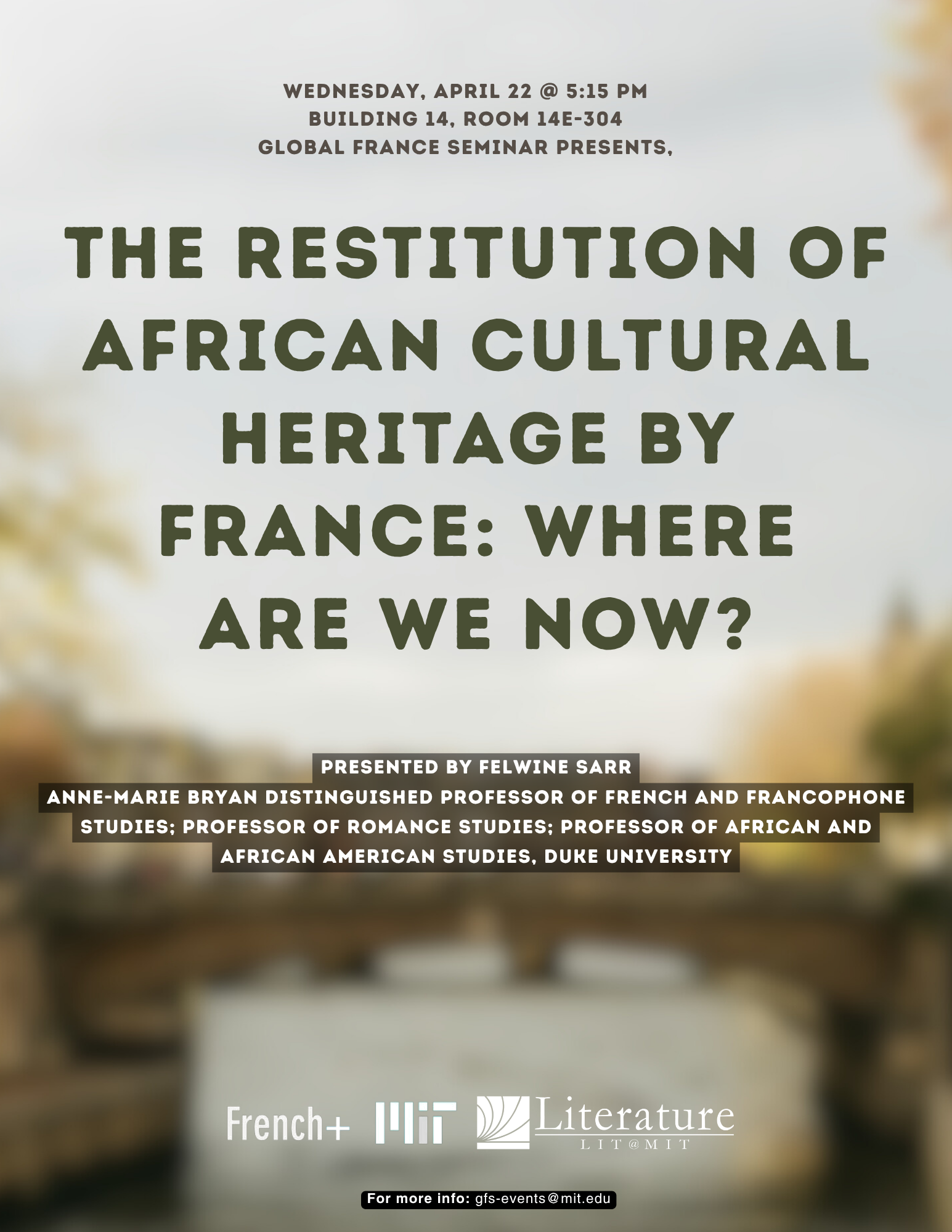 Abstract: Restitution of African heritage (cultural artifacts) by former colonial powers is an entangled issue. The questions it raises are not limited to those of legitimate ownership of objects. Its implications are political, symbolic, philosophical and relational. It opens up a reflection on history, memory, the colonial past, the genesis and development of Western museums and ethnographic collections. It also allows us to think about the different conceptions of cultural heritage, the different ways of exhibiting objects, as well as their circulation and translocations. Finally, it allows us to think about the larger question of the transmission of cultural heritage and that of the trace. I want to share with you some lessons from this experience related to history, memory, traces, re-appropriation and relationality.
Bio: Felwine Sarr is a Senegalese academic and writer. He is Anne-Marie Bryan Distinguished Professor of Romance Studies and African & African American Studies at Duke University in North Carolina, after teaching at the Université Gaston Berger in Saint-Louis, Senegal, where he is Professeur Titulaire des Universités and agrégé in economics. His academic work focuses on economics, the ecology of knowledge, contemporary African philosophy, economic policy, epistemology, economic anthropology and the history of religious ideas.
He has published Dahij (Gallimard 2009), 105 Rue Carnot (Mémoire d’Encrier 2011), Méditations Africaines (Mémoire d’Encrier 2012), Afrotopia (Philippe Rey, 2016), Ishindenshin (Mémoire d’Encrier, 2017), Habiter le Monde (Mémoire d’Encrier, 2017), Ecrire l’Afrique-monde (collective work co-edited with Achille Mbembe, Philippe Rey/Jimsaan, 2017), Restituer le patrimoine Africain (Philippe Rey/Seuil, 2018) with Bénédicte Savoy, Politique des Temps (co-edited with Achille Mbembe, Philippe Rey/Jimsaan 2019), La Saveur des derniers mètres (Philippe Rey, 2021), Traces (Actes Sud, 2021, translation into Wolof Watit, 2023, éditions EJO), l’Économie à venir (Les liens qui Libèrent, 2021) with Gaël Giraud, Les Lieux qu’Habitent mes Rêves (Gallimard, 2022) and Le Bouddhisme est né á Colobane (Philippe Rey /Jimsaan, 2024).
***
Felwine Sarr est universitaire sénégalais et écrivain. Il est Anne-Marie Bryan Distinguished Professeur d’études Romanes et d’études africaines et afro-américaines à l’Université de Duke en Caroline du Nord après avoir enseigné à l’Université Gaston Berger de Saint-Louis au Sénégal où il est Professeur Titulaire des Universités et agrégé en économie. Ses travaux académiques portent sur l’économie, l’écologie des savoirs, la philosophie contemporaine africaine, les politiques économiques, l’épistémologie, l’anthropologie économique et l’histoire des idées religieuses.
Il a publié à ce jour, Dahij (Gallimard 2009), 105 Rue Carnot (Mémoire d’Encrier 2011), Méditations Africaines (Mémoire d’Encrier 2012), Afrotopia (Philippe Rey, 2016), Ishindenshin (Mémoire d’Encrier, 2017), Habiter le Monde (Mémoire d’Encrier, 2017), Ecrire l’Afrique-monde (ouvrage collectif codirigé avec Achille Mbembe, Philippe Rey/Jimsaan, 2017), Restituer le patrimoine Africain (Philippe Rey/Seuil, 2018) avec Bénédicte Savoy, Politique des Temps (codirigé avec Achille Mbembe, Philippe Rey/Jimsaan 2019), La Saveur des derniers mètres (Philippe Rey, 2021), Traces (Actes Sud, 2021, traduction en wolof Watit, 2023, éditions EJO), l’Économie à venir (Les liens qui Libèrent, 2021) avec Gaël Giraud, Les Lieux qu’Habitent mes Rêves (Gallimard, 2022) et Le Bouddhisme est né á Colobane (Philippe Rey /Jimsaan, 2024).
Related Events


Literature Section
Massachusetts Institute of Technology
77 Massachusetts Avenue 14N-407
Cambridge, MA 02139
tel: (617) 253-3581
