

Events

Oedipus at Colonus: Marina Berzins McCoy
October 27 @ 5:15 pm
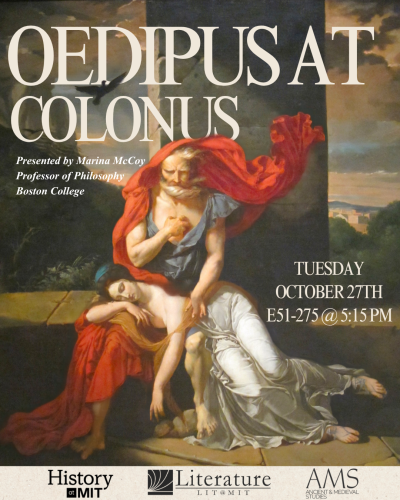 In Oedipus at Colonus, the chorus seems to suggest that life is hardly worth living, and that old age is a curse best relieved by death. However, Sophocles also offers us reflections on aging, agency, and hospitality. In Oedipus’s old age, we see the possibility of hospitality towards oneself. Second, he presents the end of Oedipus’s life as fulfillment rather than termination. Third, he comes to see that fulfillment not in terms of his life’s projects but rather as political protection of the city whose future continues after his death in a new form of mysterious presence to the polis. In all of this, Oedipus must both affirm his own agency where it is possible in life and let go of the need for agency and knowledge with respect to a full grasp of his life’s meaning.
Marina Berzins McCoy is a professor of philosophy at Boston College. She is the author of several books in ancient philosophy, including Image and Argument in Plato’s Republic (SUNY 2020) and Wounded Heroes: Vulnerability as a Virtue in Ancient Greek Literature and Philosophy (Oxford University Press, 2013). She has also written on Plato and the Sophists and on the philosophy of ancient literature.
Literature Section
Massachusetts Institute of Technology
77 Massachusetts Avenue 14N-407
Cambridge, MA 02139
tel: (617) 253-3581
