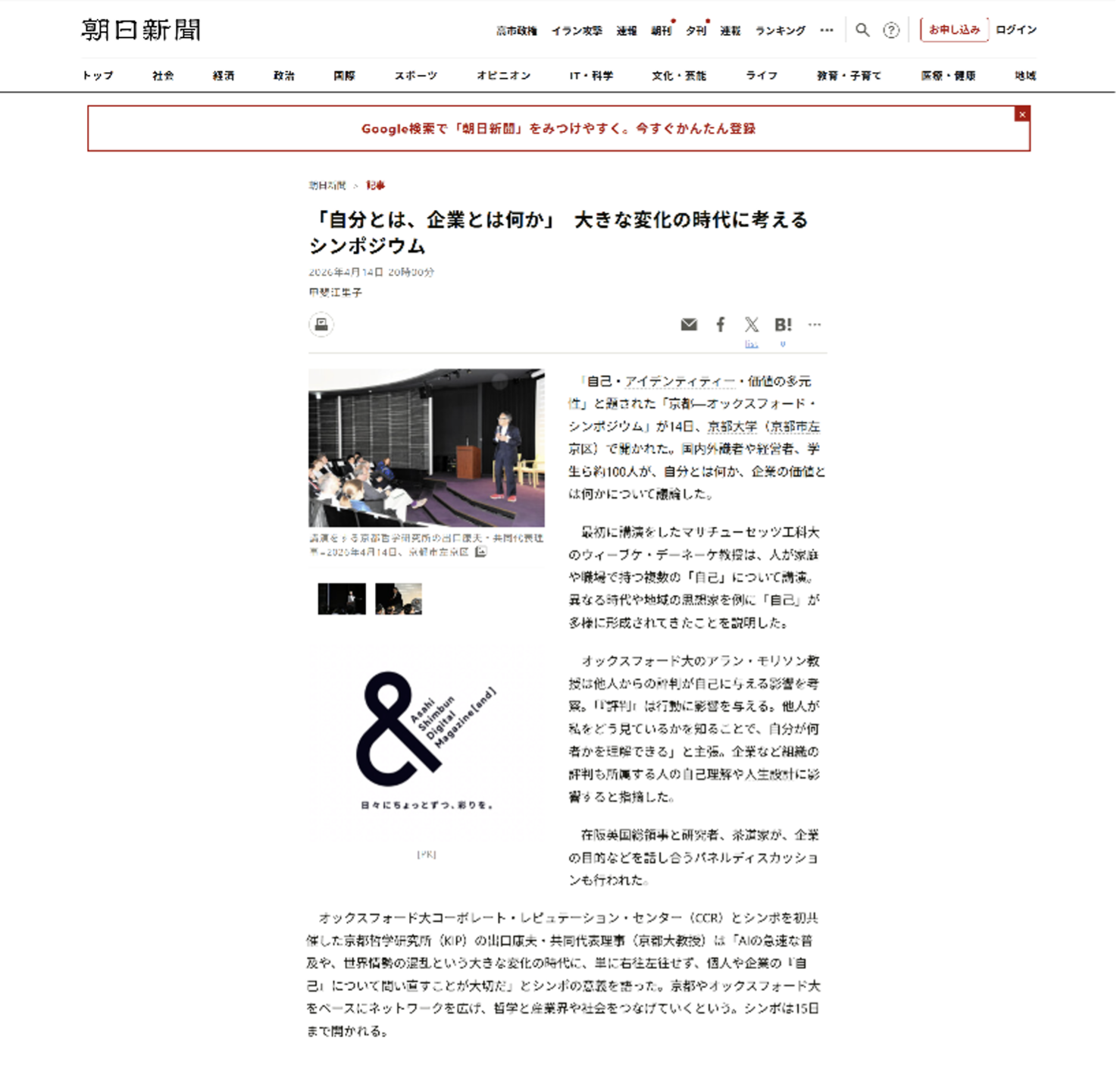

Japan’s Asahi Shimbun, one of the country’s most influential national newspapers, featured Professor Wiebke Denecke, Faculty Lead of MIT Global Humanities (GHI), and her opening lecture at the Kyoto–Oxford Symposium, “Self, Identity, and Value Plurality,” held at Kyoto University on April 14–15, 2026.
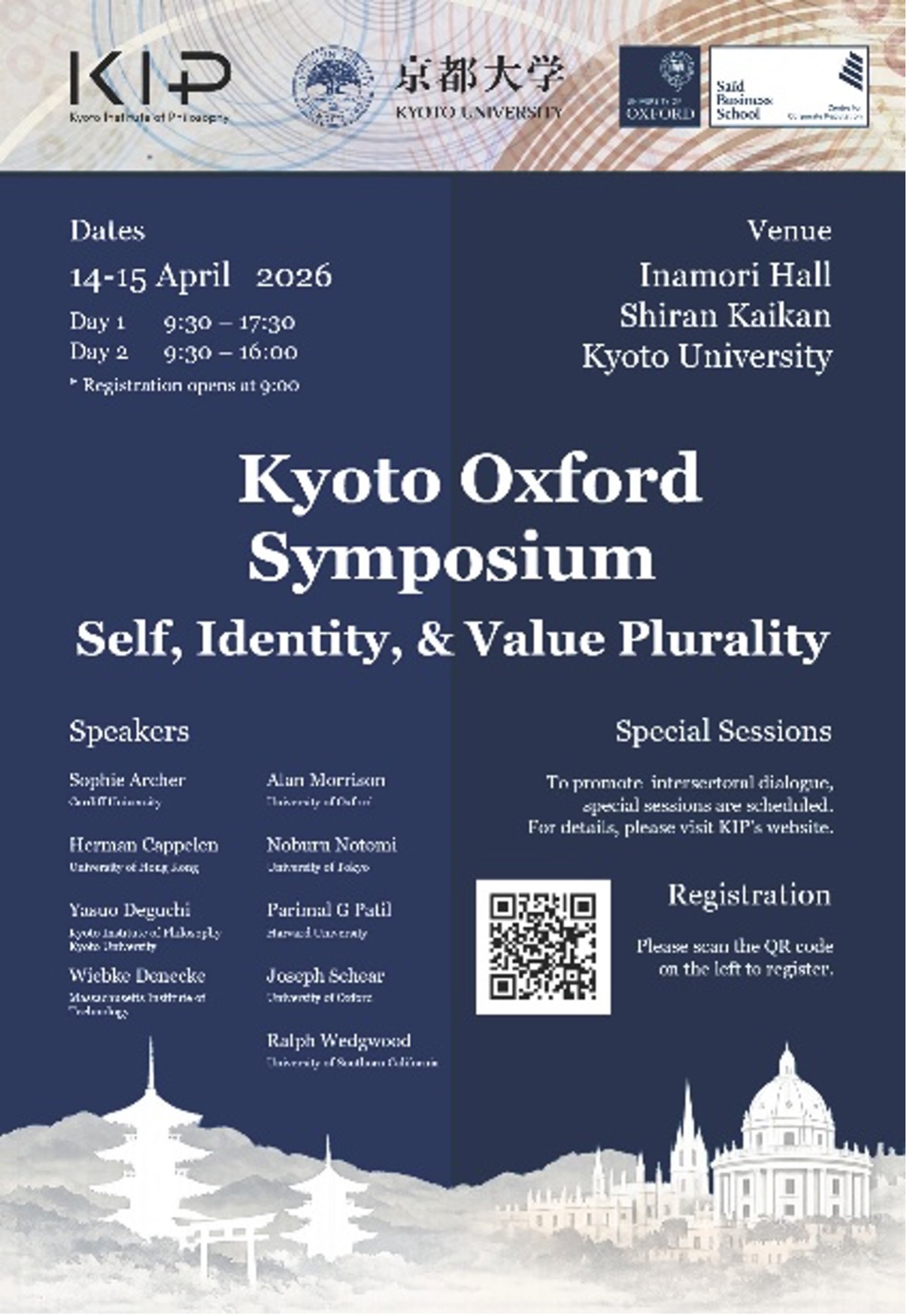
The symposium was co-hosted by the Kyoto Institute of Philosophy (KIP), Kyoto University, and the Oxford University Centre for Corporate Reputation at Saïd Business School, University of Oxford. Approximately 100 participants including Japanese and international scholars, business leaders, and students, gathered to explore questions surrounding the self, identity, and value plurality, asking fundamental questions such as “What is the self?” and “What is the value of corporations and organizations?”
The symposium was organized to reconsider how concepts such as selfhood, identity, and value plurality might be rethought in an age marked by rapid technological transformation, the spread of AI, and increasing global uncertainty. Participants included Yasuo Deguchi (Kyoto University), Alan Morrison and Joseph Schear (University of Oxford), Sophie Archer (Cardiff University), Parimal G. Patil (Harvard University), Ralph Wedgwood (University of Southern California), and Noburu Notomi (The University of Tokyo), among other philosophers and scholars from around the world.
Asahi Shimbun paid particular attention to Denecke’s opening lecture, “Plural Selves, Shared Worlds: Toward a Global Metaphilosophy of the Self.” In her lecture, Denecke reflected on the multiple “selves” people inhabit across family life, work, and society, explaining how notions of the self have been formed in highly diverse ways across different historical periods and cultural traditions. She emphasized that the self should be understood not as a singular and fixed entity, but as relational, multilayered, malleable by life moments.
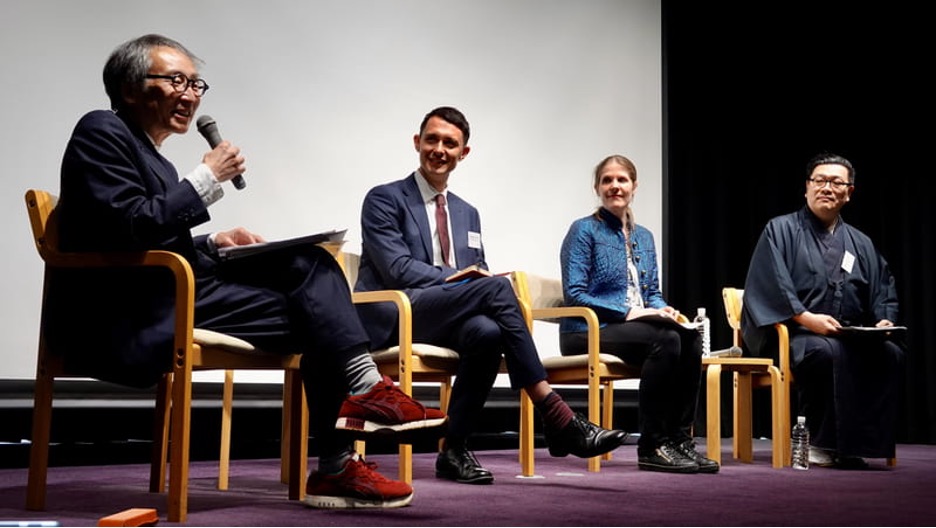
Denecke also participated in the panel discussion “Purpose in Public Life: Culture, Dialogue, and Value Plurality,” together with Michael Blyth, Consul-General at the British Consulate-General in Osaka, and Soshin Kimura, Tea Master of the Hoshinkai tea ceremony association. The panel explored the roles that diplomacy and culture can play in the pursuit of collective flourishing. Consul-General Blyth emphasized that diplomacy should not be understood as the art of ‘letting someone else have your way,’ but rather as the work of building bridges between different cultures. Referring to this bridge-building role, Kimura explained the essence of the Japanese concept of “wabi-sabi,” the deep appreciation for the transience and imperfection of all things. Picking up on both, Denecke remarked how “there is both MORE and LESS collective flourishing than ever in world history—and how tapping into Buddhist notions of “cultivation” and trust-building practices of “diplomatic intelligence” can keep us safer and saner in a chaotic world.
Asahi Shimbun described the symposium as an occasion to reconsider “what the self is” and “what the value of corporations and organizations might be” in a rapidly changing world. Yasuo Deguchi, Co-chair of the Kyoto Institute of Philosophy, stressed that in an age marked by the rapid spread of AI and growing geopolitical instability, it is essential not simply to react to change, but to rethink the very foundations of identity, purpose, and value in human society. The symposium formed part of KIP’s broader effort to connect philosophy and the humanities with public life and international society through sustained global collaboration.