

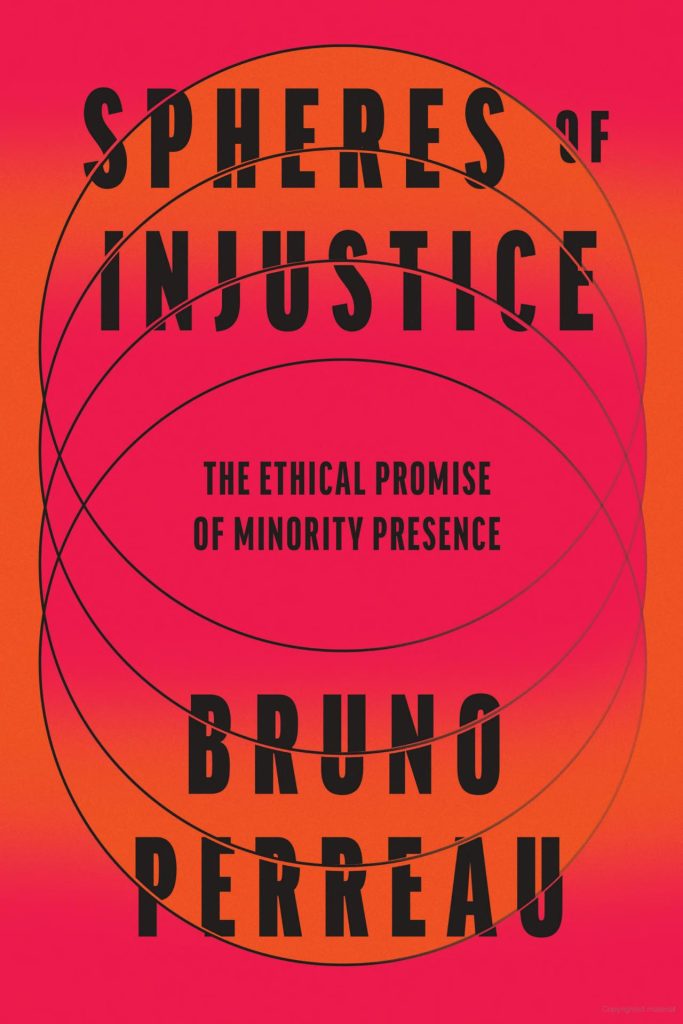
 In his newest published book, Professor Bruno Perreau explores the resonances between minority experiences –what he calls intrasectionality– and how they contribute to improving democratic systems and expanding legal protections for all. For so doing, Bruno revisits political philosopher Michael Walzer’s classical book: Spheres of Justice. “Because of the complexities of social relations, inequalities are impossible to fully erase,” Perreau says. “Even in the act of trying to resist an injustice, we may create other forms of injustice. Inequality is unavoidable, but his [Michael Walzer’s] goal is to reduce injustice to the minimum, in the form of little inequalities that do not matter that much.” Read more below about Bruno’s rethinking of justice, injustices, and minority politics today!
Bruno Perreau’s latest book, Spheres of Injustice, updates classic thought about rights and legal standing in a complex society.
In 2024, an association of female senior citizens in Switzerland won a case at the European Court of Human Rights. Their country, the women contended, needed to do more to protect them from climate change, since heat waves can make the elderly particularly vulnerable. The court ruled in favor of the group, saying that states belonging to the Council of Europe have a “positive obligation” to protect citizens from “serious adverse effects of climate change on lives, health, well-being, and quality of life.”
The exact policy implications of such rulings can be hard to assess. But there are still subtle civic implications related to the ruling that bear consideration.
For one thing, although the case was brought by a particular special-interest association, its impact could benefit everyone in society. Yet the people in the group had not always belonged to it and are not wholly defined by being part of it. In a sense, while the senior-citizen association brought the case as a minority group of sorts, being a senior citizen is not the sole identity marker of the people in it.
These kinds of situations underline the complexity of interest-group dynamics as they engage with legal and political systems. Much public discourse on particularistic groups focuses on them as seemingly fixed entities with clear definitions, but being a member of a minority group is not a static thing.
“What I want to insist on is that it’s not like an absolute property. It’s a dynamic,” says MIT Professor Bruno Perreau. “It is both a complex situation and a mobile situation. You can be a member of a minority group vis-à-vis one category and not another.”