

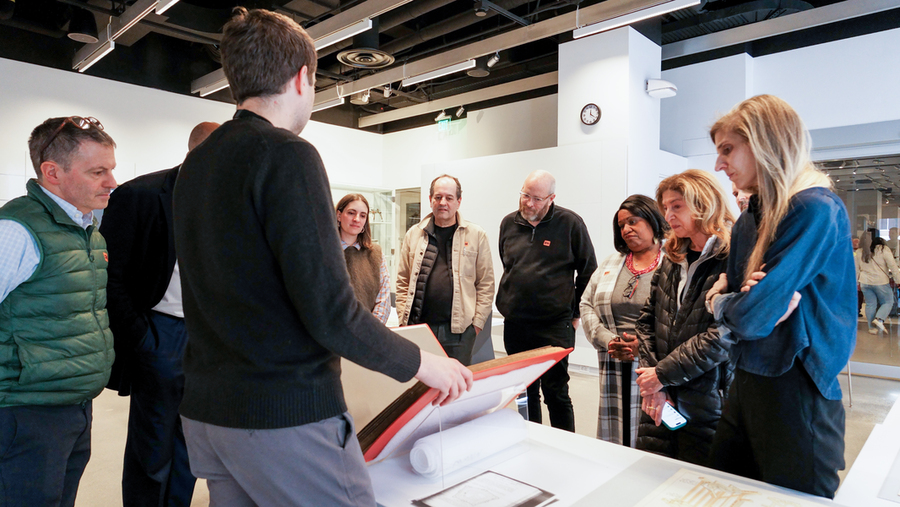
 A day of conversations and archival access at the MIT Museum reflects an ongoing exchange rooted in the work and ideas of the Institute’s first Black graduate.
Written by Michaela Jarvis for the MIT School of Architecture and Planning, published May 5, 2026
On April 10, MIT marked its first official Robert R. Taylor Day with a program centered on the life and work of Robert Robinson Taylor (Class of 1892), the Institute’s first Black graduate and the first academically trained Black architect in the United States.
After graduating from MIT, Taylor joined Tuskegee Institute (now Tuskegee University), where he designed campus buildings, developed a curriculum, and helped establish an approach to architectural education grounded in making and community life — an orientation that continues to shape the relationship between MIT and Tuskegee today…
…The day’s program — the vision for which originally emerged from a suggestion made by MIT literature professor Joshua Bennett during a meeting at Tuskegee with de Monchaux, Daniels, and Tuskegee President Mark Brown — moved into a broader effort among faculty and collaborators across architecture, history, and the humanities. As Bennett put it, “The primary aim of Robert R. Taylor Day is to lift up not only Taylor’s accomplishments, but his ideas — and the fact that his ideas live on in those of us who have inherited his legacy.”
That emphasis is also visible in the dedicated coursework and research that has accompanied the exchange since 2022. In class 4.s12 (Brick x Brick: Drawing a Particular Survey), taught by Carrie Norman, assistant professor in architecture at MIT, students document buildings on the Tuskegee campus through measured drawings and archival interpretation. Working from limited historical material, they reconstruct both form and intent.
“My role has been to structure this work pedagogically,” Norman says, “guiding students in methods of close looking, measured drawing, and archival interpretation.” She describes Taylor’s work as “an ongoing research agenda,” adding that “the broader aim is not only to deepen engagement with Taylor’s legacy, but to build on it through new forms of design research.”
Related work has contributed to a recent exhibition on the Tuskegee Chapel at the National Building Museum, curated by Helen Bechtel of the Yale School of Architecture. Building on research conducted in Norman’s course, students developed large-scale models that form part of the exhibition. New 3D fabrications use a limited set of archival materials to reconstruct the chapel originally designed by Taylor as the first electrified building in Alabama’s Macon County, which was destroyed by fire in 1957.