

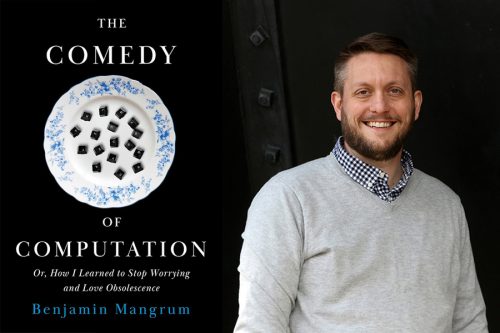
Caption: In his new book “The Comedy of Computation,” MIT literature professor Benjamin Mangrum explores how we deal with our doubts and fears about computing through humor.
Credit: Courtesy of Stanford University Press; Allegra Boverman
Associate Professor Benjamin Mangrum’s new book explores how we use comedy to cope with the growth of computer technology in modern life.
MIT News discusses Literature’s Professor Ben Mangrum’s newest book The Comedy of Computation: Or How I Learned to Stop Worry and Love Obsolescence with Peter Dizikes. Fear, humor, and the ethics of authenticity factor into our cultural understanding of computers. Ben explores the interconnections and complications that factor into our technological landscape.
“There’s this really complicated, messy picture,” Mangrum says. “And comedy sometimes finds a way of experiencing and finding pleasure in that messiness, and other times it neatly wraps it up in a lesson that can make things neater than they actually are.”
Ben, in addition to his newest book release, will be teaching two new courses this Spring 2025 “21L.050 Reading Nonfiction (New!): The Art of Seeing Things” and “21L.450 Global Environmental Literature (New!): Ecofeminism.”
–
The first time Steve Jobs held a public demo of the Apple Macintosh, in early 1984, scripted jokes were part of the rollout. First, Jobs pulled the machine out of a bag. Then, using speech technology from Samsung, the Macintosh made a quip about rival IBM’s mainframes: “Never trust a computer you can’t lift.”
There’s a reason Jobs was doing that. For the first few decades that computing became part of cultural life, starting in the 1950s, computers seemed unfriendly, grim, and liable to work against human interests. Take the 1968 film “2001: A Space Odyssey,” in which the onboard computer, HAL, turns against the expedition’s astronauts. It’s a famous cultural touchstone. Jobs, in selling the idea of a personal computer, was using humor to ease concerns about the machines.
“Against the sense of computing as cold and numbers-driven, the fact that this computer was using voice technology to deliver jokes made it seem less forbidding, less evil,” says MIT scholar Benjamin Mangrum.
In fact, this dynamic turns up throughout modern culture, in movies, television, fiction, and the theater. We often deal with our doubts and fears about computing through humor, whether reconciling ourselves to machines or critiquing them. Now, Mangrum analyzes this phenomenon in a new book, “The Comedy of Computation: Or, How I Learned to Stop Worrying and Love Obsolescence,” published this month by Stanford University Press.
“Comedy has been a form for making this technology seem ordinary,” says Mangrum, an associate professor in MIT’s literature program. “Where in other circumstances computing might seem inhuman or impersonal, comedy allows us to incorporate it into our lives in a way that makes it make sense.”