

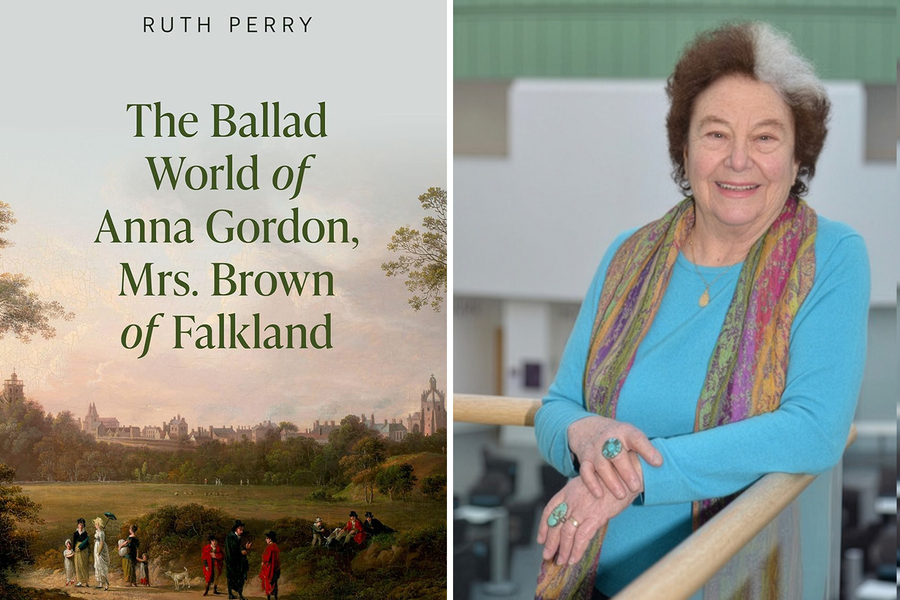
Featured this month in the MIT News, Literature’s Ann Fetter Friedlaender Professor of Humanities, Emerita Ruth Perry discusses her new book profiling Anna Gordon, a Scotswoman who preserved and transmitted precious popular ballads, and with them, national traditions.
Traditional folk ballads are one of our most enduring forms of cultural expression. They can also be lost to society, forgotten over time. That’s why, in the mid-1700s, when a Scottish woman named Anna Gordon was found to know three dozen ancient ballads, collectors tried to document all of these songs — a volume of work that became a kind of sensation in its time, a celebrated piece of cultural heritage.
That story is told in MIT Professor Emerita Ruth Perry’s latest book, “The Ballad World of Anna Gordon, Mrs. Brown of Falkland,” published this year by Oxford University Press. In it, Perry details what we know about the ways folk ballads were created and transmitted; how Anna Gordon came to know so many; the social and political climate in which they existed; and why these songs meant so much in Scotland and elsewhere in the Atlantic world. Indeed, Scottish immigrants brought their music to the U.S., among other places.
Q: This is fascinating topic with a lot of threads woven together. To you, what is the book about?
A: It’s really three books. It’s a book about Anna Gordon and her family, a very interesting middle-class family living in Aberdeen in the middle of the 18th century. And it’s a book about balladry and what a ballad is — a story told in song, and ballads are the oldest known poetry in English. Some of them are gorgeous. Third, it’s a book about the relationship between Scotland and England, the effects of the Jacobite uprising in 1745, social attitudes, how people lived, what they ate, education — it’s very much about 18th century Scotland.