

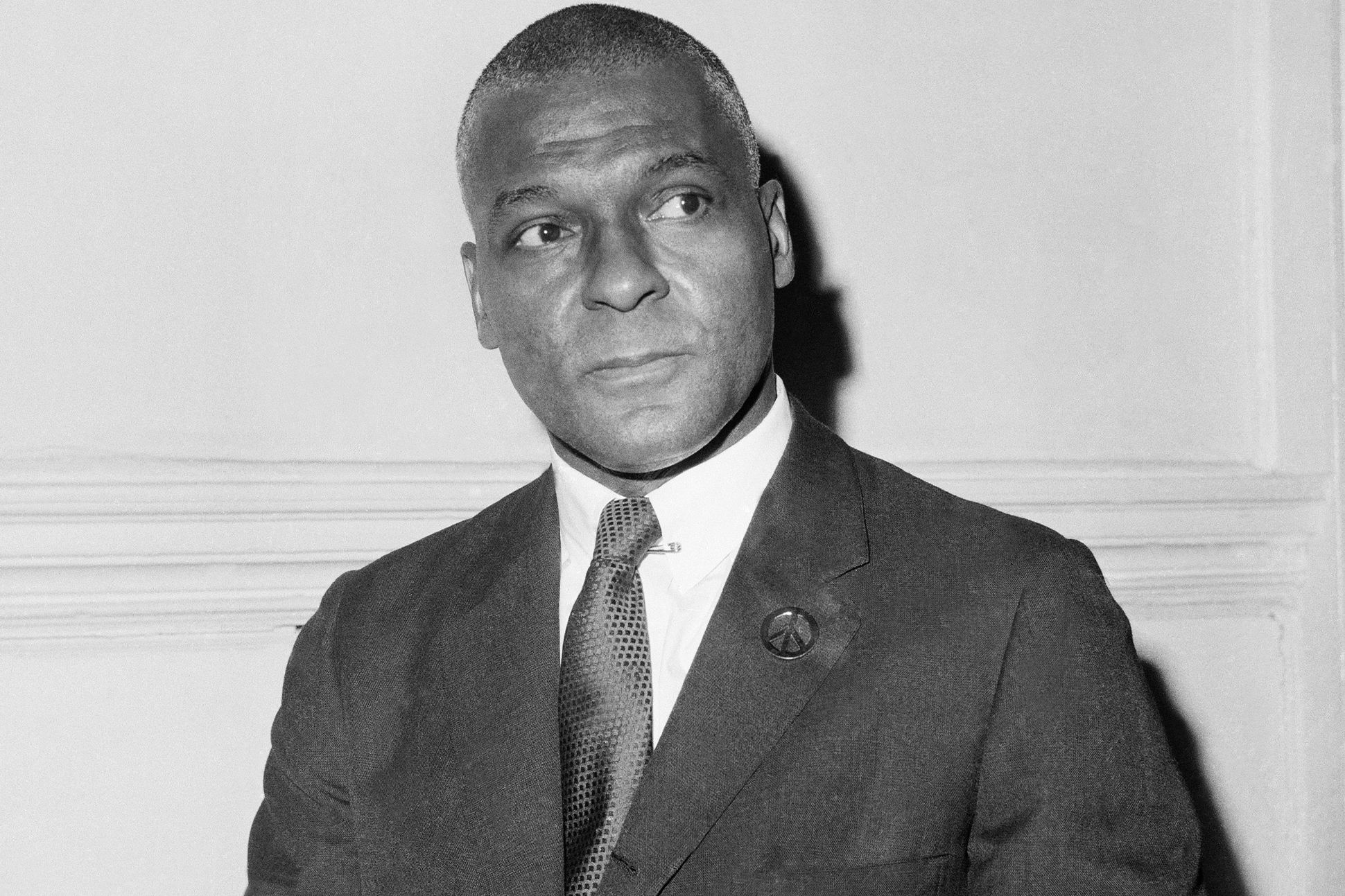
Bruce M. Wright photographed by: Anthony Camerano, Associated Press
Written by Prof. Joshua Bennett:
For Bruce M. Wright—a lawyer, judge, and poet who lived through Jim Crow—words held worldmaking force.
Ordinary language breaks down in extraordinary cases.
—J.L. AustinThere is tenderness only in the coarsest demand: that no-one shall go hungry any more.
—Theodor Adorno
The lawyer-poet—or put more precisely, the working poet formally trained and accredited in the practice of law—is an understudied figure in US literary history. Consider this brief accounting of 20th and 21st century bards who fit the bill: James Weldon Johnson, Martín Espada, Evie Shockley, Archibald MacLeish, Monica Youn, Edgar Lee Masters, Reginald Dwayne Betts, Wallace Stevens. On one hand, this constellation seems to encapsulate the American tradition’s sheer aesthetic breadth. In another, more expansive sense, it reminds us that our desire for poetic language—like our dedication to the language of laws broadly construed, be they religious, physical, or otherwise—also constitutes a striving toward a more precise vocabulary for human and nonhuman activity alike at every level: from the cosmic to the microscopic, the ethereal to the mundane, and all their points of intersection and entanglement.
But what is the essential bridge between poetry and law? Is it the belief that language is not solely a carrier of meaning, but a mechanism for deducing some deeper reality beyond what is readily visible? A means through which we might illuminate what remains shadowed across time and see how the past constrains what we hope to one day become? Where the poetic and the jurisprudential collide is where the chorus of history awakens to clarify and complicate our current state of affairs: the voices of the living and dead gliding across a citational chain to set precedents and parameters, shaping the limits of the present day. These appear to us as edicts, cases, lines of verse: the collective memory of our civilizations enfolded in amber, if not etched in stone.
The 20th century poet, attorney, and judge Bruce M. Wright is an anomaly even among the ensemble of authors I have already mentioned. He represents a historically noteworthy case of the lawyer-poet in more ways than one: rather than his legal training serving as foundational support for a life dedicated to the art of crafting poems, for example, something like the inverse occurred. His work as a freedom fighter was energized, at every turn, by his vision as a poet. His legal scholarship, as well as his public speeches, were clearly products of a deep education in the literary arts and an investment in poetry as a means through which we might deploy “heightened language,” to use the critic Christopher Caudwell’s phrase, to navigate the distance between reality and illusion, delusion and the more beautiful, future world that words might help us make. Wright embodied the best of what the practice of poetry offers us: both the inspiration to go against the grain of the present world and the instruments needed to reshape that world, remaking it each day through the ritual reinvention of our shared language…
Read more here: https://www.poetryfoundation.org/articles/1797411/extraordinary-cases