Home About LIT@MIT People Program Research Resources Spotlight FAQ Contact
Research

booksThe range of individual faculty research interests is rich and wide. Special strengths include: colonialism, postcolonialism, and the literature of travel; early modern literature and culture; and science, technology, and modernity. In addition, the close collaboration between the Literature and Comparative Media Studies programs at MIT underpins ongoing research on such topics as television history, the history of the book, and popular literary, visual and musical culture. The particular work of individual Literature faculty may be found on their personal websites (accessible through the People page).

Beyond the work of individuals, Literature at MIT supports a number of collective research initiatives that involve faculty and students from Literature as well as other associated departments at MIT. Described below are four major ongoing collective initiatives that combine research and pedagogy: The MIT Shakespeare Project, Metamedia, MIT Communications Forum, and The Kainan University (Taiwan)-MIT Exchange.

leaf

MIT Shakespeare Project

Since 1992, The MIT Shakespeare Project has been constructing electronic environments for teaching and research based on digital copies of primary documents in all media, including texts, high resolution page images of early editions, digital collections of art, illustration and stage photographs, and film and video adaptations. A collaborative venture between the Literature Section and the Center for Educational Computing Initiatives (CECI) with funding from the Microsoft I-Campus Initiative, the project uses the latest technologies to create exemplary digital collections in all media by building alliances with libraries, publishers, and theatrical companies, design systems of access in which all materials are linked to the lines of text to which they are relevant and which are easily used at all levels -- from advanced scholars to university and high school students and the general "reader" and deliver a variety of archival resources to users through special collections available at research libraries and partner universities, publications on CD-ROM or DVD-ROM, and the World Wide Web.

For more information, please visit the MIT Shakespeare Project website at http://web.mit.edu/shakspere/index.html.

leaf

Metamedia

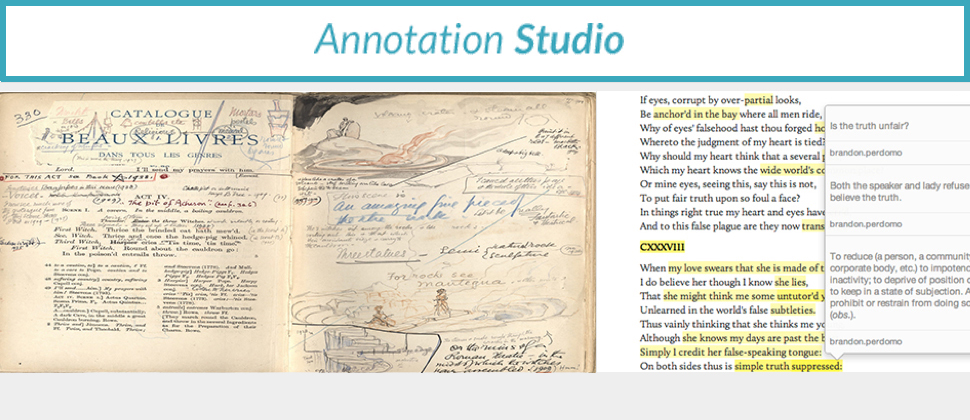
The Metamedia project provides students and faculty with a flexible online environment to create, annotate and share media-rich documents for the teaching and learning of core humanistic subjects. Using the open standards-based Metamedia framework, faculty members further pedagogical innovation by building subject-specific mini-archives that extend the use of multimedia materials in the classroom and enable the formation of learner communities across disciplines and distances. Drawing on Metamedia applications as they research, develop, and collaborate on multimedia essays or in-class presentations, students improve their media literacy skills and gain a better understanding of how media influences their lives and shapes their interpretations. The result is increased skill at communicating effectively in today's increasingly global world of education and business.

For more information, please visit the Metamedia website at http://metamedia.mit.edu.

leaf

MIT Communications Forum

For more than twenty-five years the Communications Forum has played a unique role at MIT and beyond as a site for cutting-edge discussion of the cultural, political, economic and technological impact of communications, with special emphasis on emerging technologies.

Leading scholars, journalists, media producers, political figures and corporate executives have appeared at conferences and panels sponsored by the Forum.

Translating specialized or technical perspectives into a discourse accessible to non-specialists is a defining ambition of the Forum. When engineers, scientists, other academics or media practitioners address the Forum, they accept a responsibility to speak in a common language that must be understood and used by literate citizens and professionals in many fields.

The Forum's founding director was the late Ithiel de Sola Pool of the MIT Political Science Department, a pioneer in the study of communications.

The Forum is funded by contributions from members of the MIT Industrial Liaison Program, other corporations and foundation grants.

For more information, please visit the Communications Forum website at http://web.mit.edu/comm-forum/.

leaf

Kainan University (Taiwan) - MIT Exchange

Inaugurated in January 2006, the MIT-Kainan Exchange program will bring as many as four special students and two visiting scholars from Kainan University, Taiwan, to MIT each year. Supervised by Prof. David Thorburn, the partnership aims to fortify and extend the multi-cultural interests of the MIT Communications Forum, and of the programs in Literature and CMS.

Thorburn, who is director of the Forum, conceived the Exchange during a visit to Taiwan in March, 2005, when he gave lectures on new media and met Michael Tang, president of Kainan University. He returned to Taiwan in August to sign a Memorandum of Understanding between MIT and the Taiwan institution.

Literature and CMS offerings will form the core of the students' curriculum, though they will also be eligible to enroll in other MIT subjects appropriate to their interests.

The collaboration will also support a bi-annual conference in Taiwan at which communications scholars from MIT and other American universities will be featured. The Communications Forum will organize these conferences.

The agreement provides for the program to continue for five years, and to be extended for another five-year term by mutual consent of both institutions.