

 Written by Kate Marshall, Thomas J. and Robert T. Rolfs College Professor of English at the University of Notre Dame, where she also serves as Associate Dean for Research and is Director of the Franco Institute. She is the author, most recently, of Novels by Aliens: Weird Tales and the Twenty-First Century (2023).
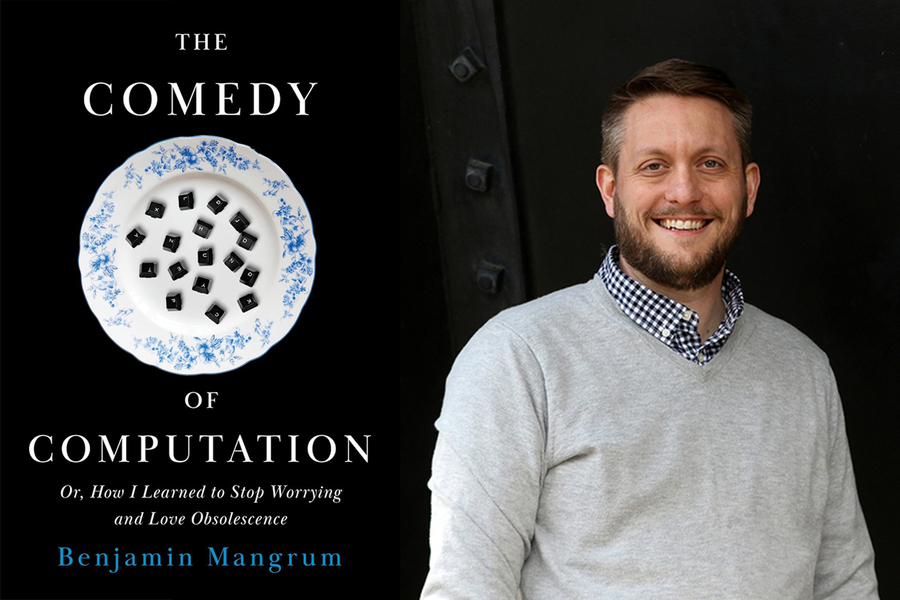
Review of The Comedy of Computation: Or, How I Learned to Stop Worrying and Love Obsolescence by Prof. Benjamin Mangrum
___________________________
It’s easy to feel guilty about finding anything related to the world of automation funny, now or in its history. I live next door to one of the world’s largest data centers, which seems by most accounts to be uninhibited in its rampaging of the groundwater and local electrical grid, and I talk regularly with new and temporary neighbors drawn to an unforgiving climate by the demands for its construction. And yet, the absurdities of our computational moment exert a tremendous pull, and my cultural tastes on this topic are far from limited to the dystopian.
Benjamin Mangrum’s The Comedy of Computation: Or, How I Learned to Stop Worrying and Love Obsolescence explains why that might be. It provides a clear and culturally rich account of why comedy has been and continues to be central to our experience of the contradictions of computation since the mid-twentieth century. Late in the book he unpacks the compensations of comedy in an age of growing anxiety over automation: if comedy is what we want, he says, this may signal a desire for “some pleasure and happiness in an unfunny world” (p. 197).
At the heart of Mangrum’s study are the comedic genres that provide the infrastructure for navigating the moment where anticipation of the future collides with obsolescence, or the feeling of being behind. In these cultural encounters with computation, we see how the social itself is constructed. Mangrum shows early in the volume how a range of tropes and approaches to genre (genericness) are crucial to understanding the story of technology since mid-century and then moves to examples including satire and the absurd.
Read more here: https://criticalinquiry.uchicago.edu/kate_marshall_reviews_the_comedy_of_computation/