

Events
Calendar of Events
S Sun
M Mon
T Tue
W Wed
T Thu
F Fri
S Sat
0 events,
1 event,

0 events,
0 events,
0 events,
1 event,
8th MIT Global Humanities Forum on “Athletes, Equality & Diplomacy” on March 6 (online)
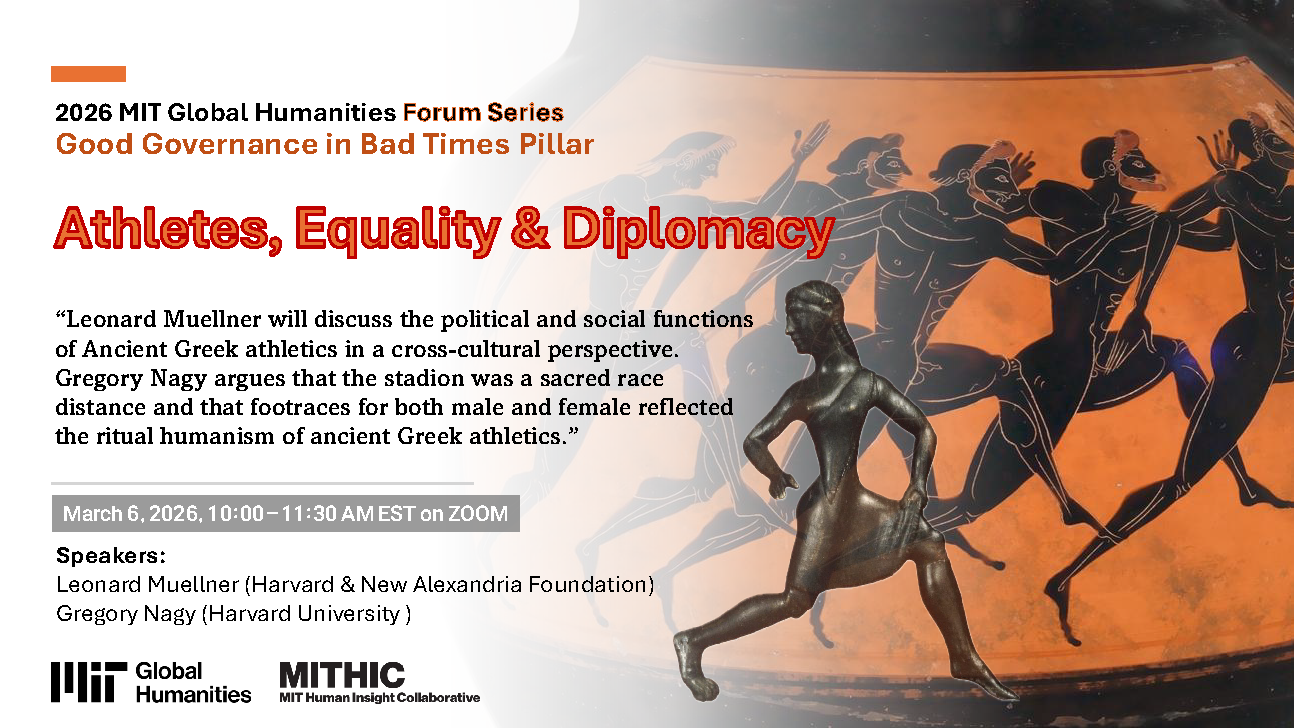
8th MIT Global Humanities Forum on “Athletes, Equality & Diplomacy” on March 6 (online)
8th GHI Forum Title: Athletes, Equality & Diplomacy Date: March 6, 2026, 10:00–11:30 AM EST Where: Online (Zoom Registration Link: https://mit.zoom.us/meeting/register/K1xD3FjiQ6KbpReKezqcxw) Speakers: Gregory Nagy, Leonard Muellner 【Abstract】 Leonard Muellner will discuss the political and social functions of Ancient Greek athletics in a cross-cultural perspective. Ancient Greece was a highly differentiated political space, consisting of a wide variety of city-states each with different religious calendars, law codes, constitutions, etc. These communities were in principle in a state of war with one another (understanding that 'war' could be ritualized combat rather than actual fighting), so that enabling participation in games across the city-states required a global truce. Greeks derived a common identity from their participation in athletics. However, there were no team games, only one person was awarded a prize in each contest, and the skills involved were at their core individualized warrior skills in a ritualized (that is, theoretically, non-fatal) context. Muellner will go on to compare this elitist way of gaming with the way sport functions in other cultures, including contemporary settings historically derived from it. The word stadium—or stadion in ancient Greek—originally did not refer to any colossal structure built for sports events. Rather, it referred to a sacred […]
0 events,
0 events,
1 event,
Ancient & Medieval Studies Colloquium presents, Matthew Gabriele “Inside Angelbert was Two Wolves, Both Feasting on an Early Medieval Empire: Fontenoy, 841”
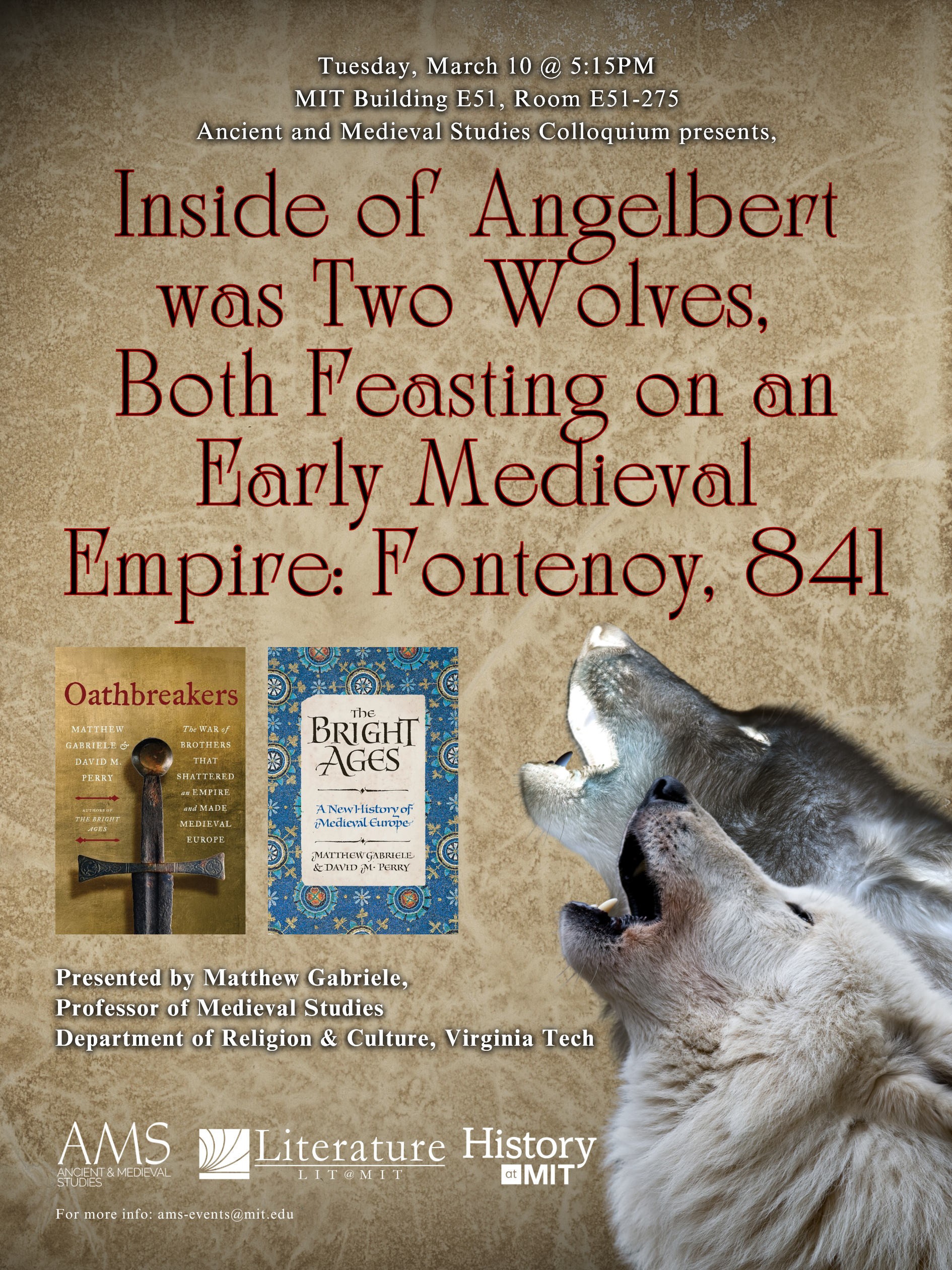
Ancient & Medieval Studies Colloquium presents, Matthew Gabriele “Inside Angelbert was Two Wolves, Both Feasting on an Early Medieval Empire: Fontenoy, 841”
Presented by Matthew Gabriele Professor of Medieval Studies Department of Religion & Culture, Virginia Tech Abstract: At the end of the 8thcentury, the Franks under their new Carolingian kings built an empire that spanned Europe and inspired the respect of both emperor(s) in Byzantium and caliphs in Baghdad. But by the middle of the next century, the empire was in tatters. In June 841, a field outside Auxerre (in modern France) lay drenched in blood, as old friends killed one another, as brother fought brother. This talk will focus on the fateful battle of Fontenoy in June 841 and particularly the account of 1 participant – a warrior named Angelbert and the poem he wrote about the battle, detailing how an empire that seemed so secure, so tightly bound in its political and cultural consensus, could be destroyed so quickly by greed and vengeance over a disputed succession to power. Bio: Matthew Gabriele is a professor of medieval studies at Virginia Tech,. His research and teaching cover the European Middle Ages, ideas of religion and violence, as well as nostalgia and apocalypse. He has written forThe Washington Post, CNN, Smithsonian Magazine, and MSNBC, among others, and interviews with him have appeared on […]
1 event,
MIT Literature Section presents, Author Talk & Live Musical Performance with Ling Ling Huang
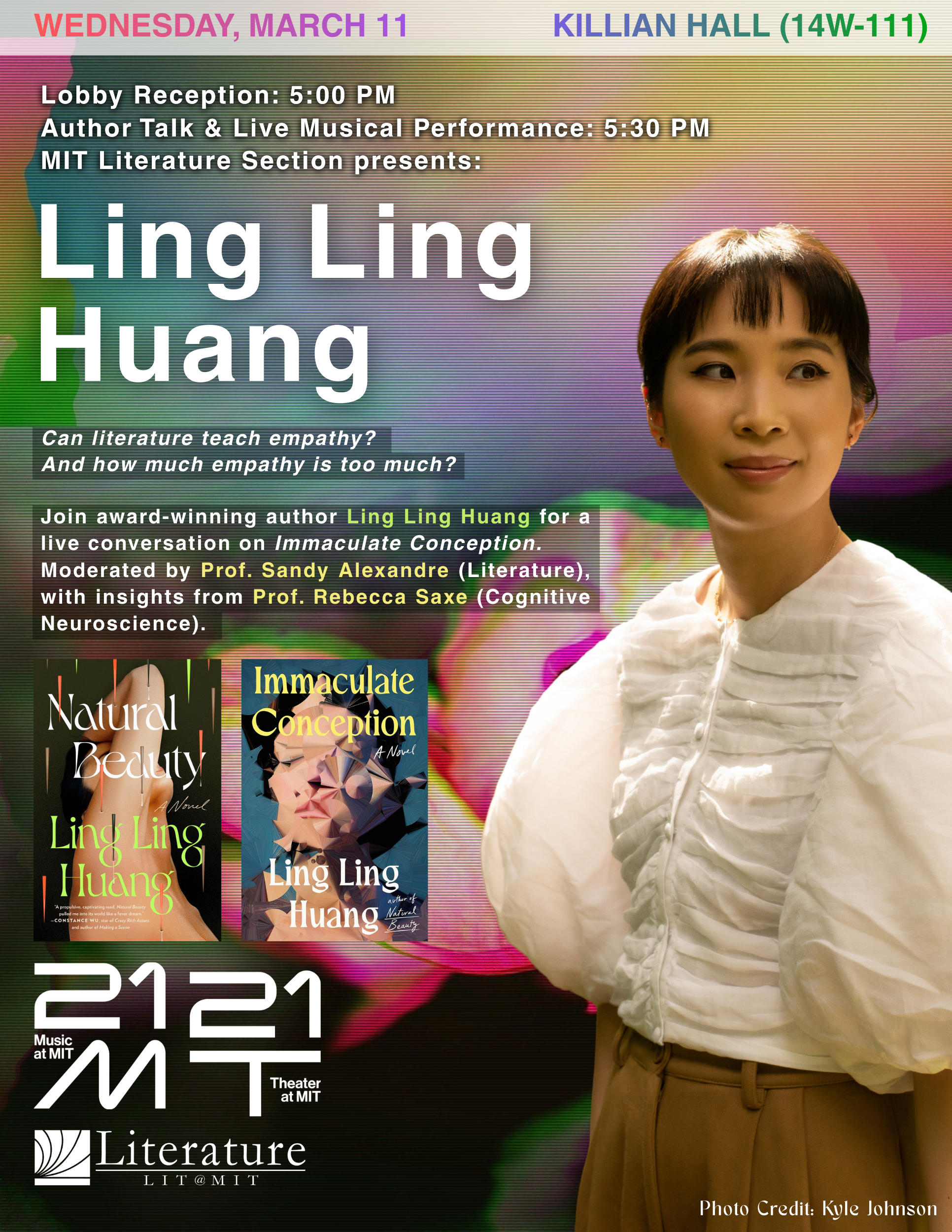
MIT Literature Section presents, Author Talk & Live Musical Performance with Ling Ling Huang
Reception: Hayden Library Courtyard @ 5:00 - 5:30 PM Author Talk & Live Musical Performance: Killian Hall (14S-111) @ 5:30 PM Can literature teach empathy? And how much empathy is too much? Join award-winning author Ling Ling Huang for a live conversation on Immaculate Conception. Moderated by Prof. Sandy Alexandre (Literature), with insights from Prof. Rebecca Saxe (Cognitive Neuroscience). Together, they’ll explore empathy in fiction: its power, its limits, and what science can tell us about it. Music will be part of the experience. See you there. Looking forward to your questions for the Q&A period after the conversation. Ling Ling Huang is a writer and violinist. She plays with several ensembles, including the Oregon Symphony, Grand Teton Music Festival Orchestra, ProMusica Chamber Orchestra, and the Experiential Orchestra, with whom she won a Grammy Award in 2021. Her debut novel, Natural Beauty, was a Good Morning America Buzz Pick, a New York Times Editors’ Choice, and a winner of the Lambda Literary Award for Bisexual Fiction. Her second novel, Immaculate Conception, was published in May 2025. Register here!
0 events,
0 events,
0 events,
0 events,
1 event,
HumaniTea
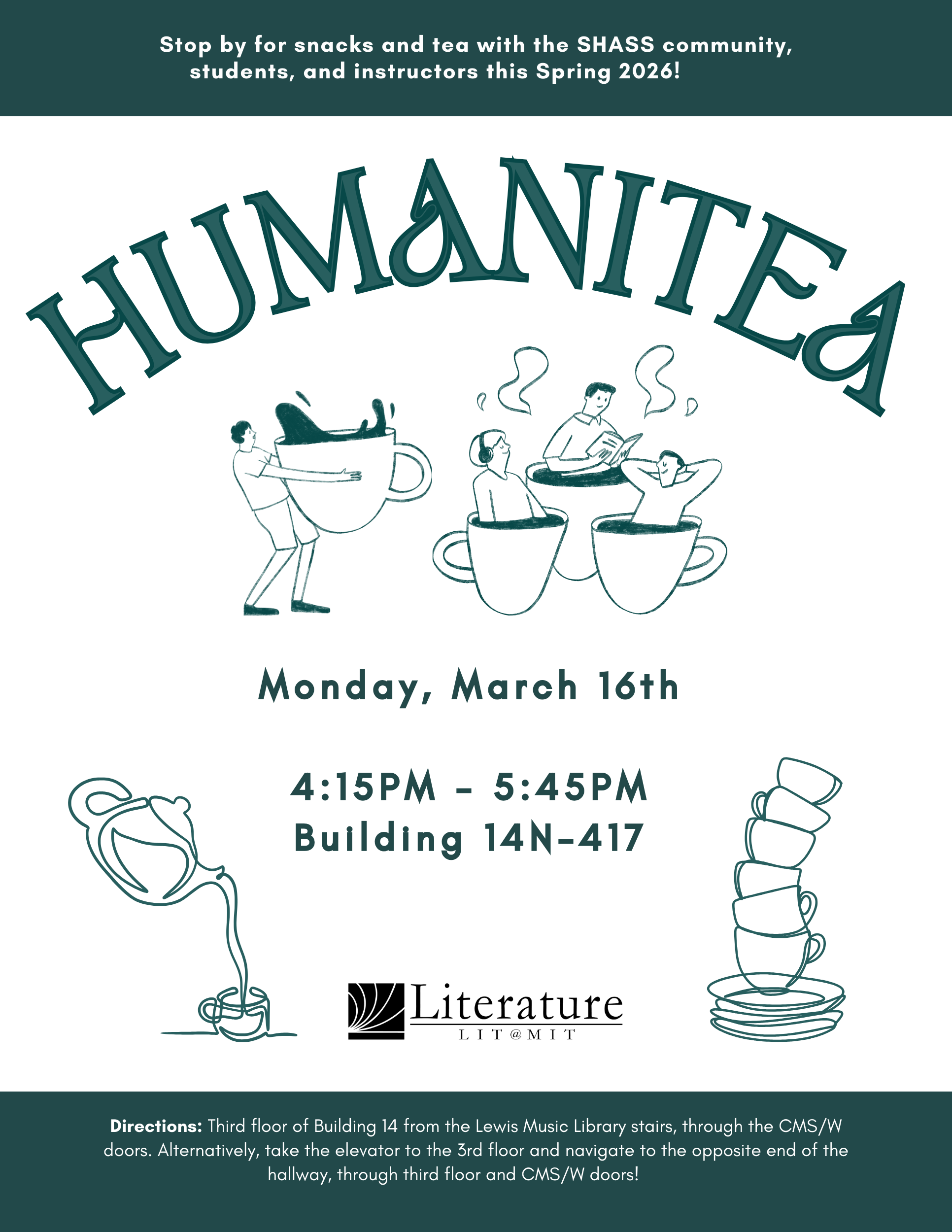
HumaniTea
Stop by for snacks and tea with the SHASS community, students, and instructors! HumaniTea is a program partnering with other units in SHASS to gather, share some food and thought, and enrich our shared MIT experience in the process. Once a month, SHASS community members, instructors, and students from diverse fields of studies, backgrounds, and interests can stop in and enjoy a cup of tea or snack. Monday, March 16 @ 4:15 - 5:45PM
1 event,
MIT GHI Master class presents, Hospicing and Outgrowing Modernity: Lecture & Discussion with Vanessa de Oliveira Andreotti
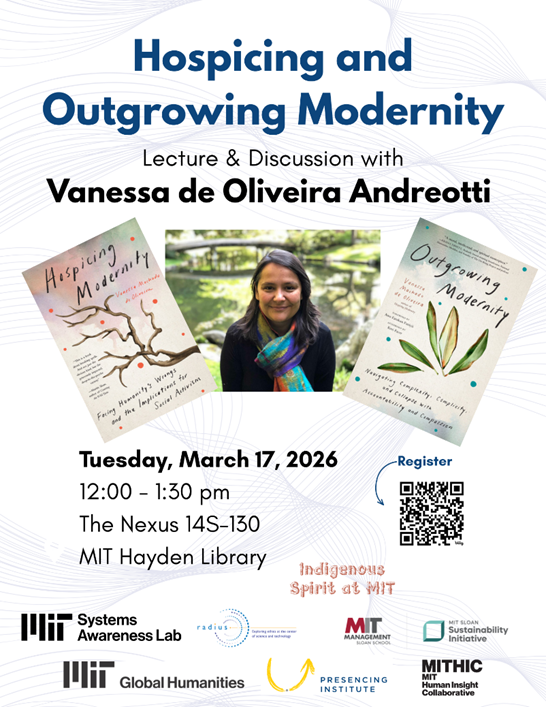
MIT GHI Master class presents, Hospicing and Outgrowing Modernity: Lecture & Discussion with Vanessa de Oliveira Andreotti
Dear colleagues, students, and friends, Join us for a lecture and discussion with internationally renowned scholar, educator, and author Vanessa de Oliveira Andreotti, a leading voice on decolonial futures, global justice, and the profound transformations required in times of social and ecological breakdown. 4th Global Humanities Master Class Title: Hospicing and Outgrowing Modernity: Tuesday, March 17, 12:00 - 1:30 pm Location: The Nexus at Hayden Library, 14S-130, 160 Memorial Drive, Cambridge, MA Vanessa de Oliveira Andreotti is the former Dean of the Faculty of Education at the University of Victoria. She is the author of Hospicing Modernity: Facing humanity's wrongs and the implications for social activism and Outgrowing Modernity: Navigating complexity, complicity and collapse (August 2025), and one of the founders of the Gesturing Towards Decolonial Futures Arts/Research Collective. Her latest work, Burnout From Humans: A Little Book About AI That is Not Really About AI, explores AI as a mirror and metaphor for human systems and invites readers to rethink relationality amidst planetary crises. Co-sponsored by MIT Global Humanities Initiative, MITHIC, MIT Systems Awareness Lab, Indigenous Spirit at MIT, MIT Radius, MIT Sloan Sustainability Initiative, and the Presencing Institute. Learn more and register: https://bit.ly/4rSX7RR Looking forward to seeing you at our […]
1 event,
WGS presents, “Gender, Empire, and AI: Symposium and Design Workshop”
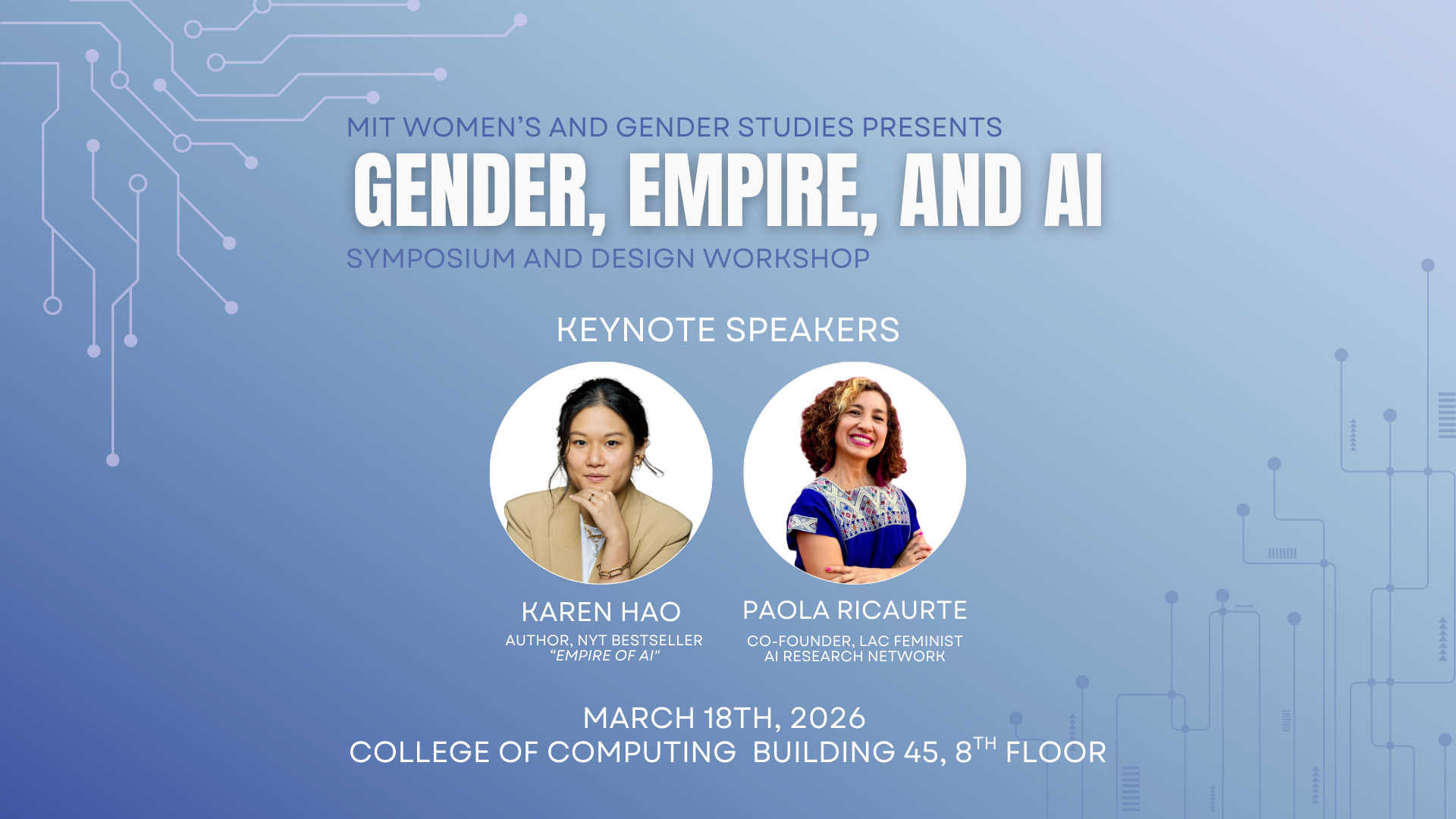
WGS presents, “Gender, Empire, and AI: Symposium and Design Workshop”
"Gender, Empire and Al" is a symposium and design workshop to both reflect on critical questions and design generative paths forward to addressing them. The day will start with a keynote by award-winning journalist and MIT alumna, Karen Hao, on her book "Empire of Al". Select MIT faculty will facilitate discussion groups to unpack problems outlined in Hao’s talk and possible solutions. Over lunch, we will hear from our second keynote speaker, Paola Ricaurte, who leads the Latin American Feminist Al Research Network and was named as one of Time Magazine's 100 most influential people in Al in 2025. In the afternoon, we will hold hands-on design workshops to tackle specific issues like reproductive justice, Al and propaganda, and biases in medical imaging. We believe that together we can solve complex issues and generate more just and feminist visions for Al and society. For more information, to register, and questions regarding accessibility, contact wgs@mit.edu.. This event is free and open to the public with priority to the MIT community. Registration is required. Learn more here... Keynote Speakers Karen Hao was formerly a reporter for The Wall Street Journal, covering American and Chinese tech companies, and a senior editor for […]
0 events,
0 events,
0 events,
0 events,
0 events,
0 events,
0 events,
0 events,
0 events,
0 events,
0 events,
2 events,
Ancient & Medieval Studies Colloquium presents, Dan Smail “Practices of Slavery in Mediterranean Europe, 1250-1500”
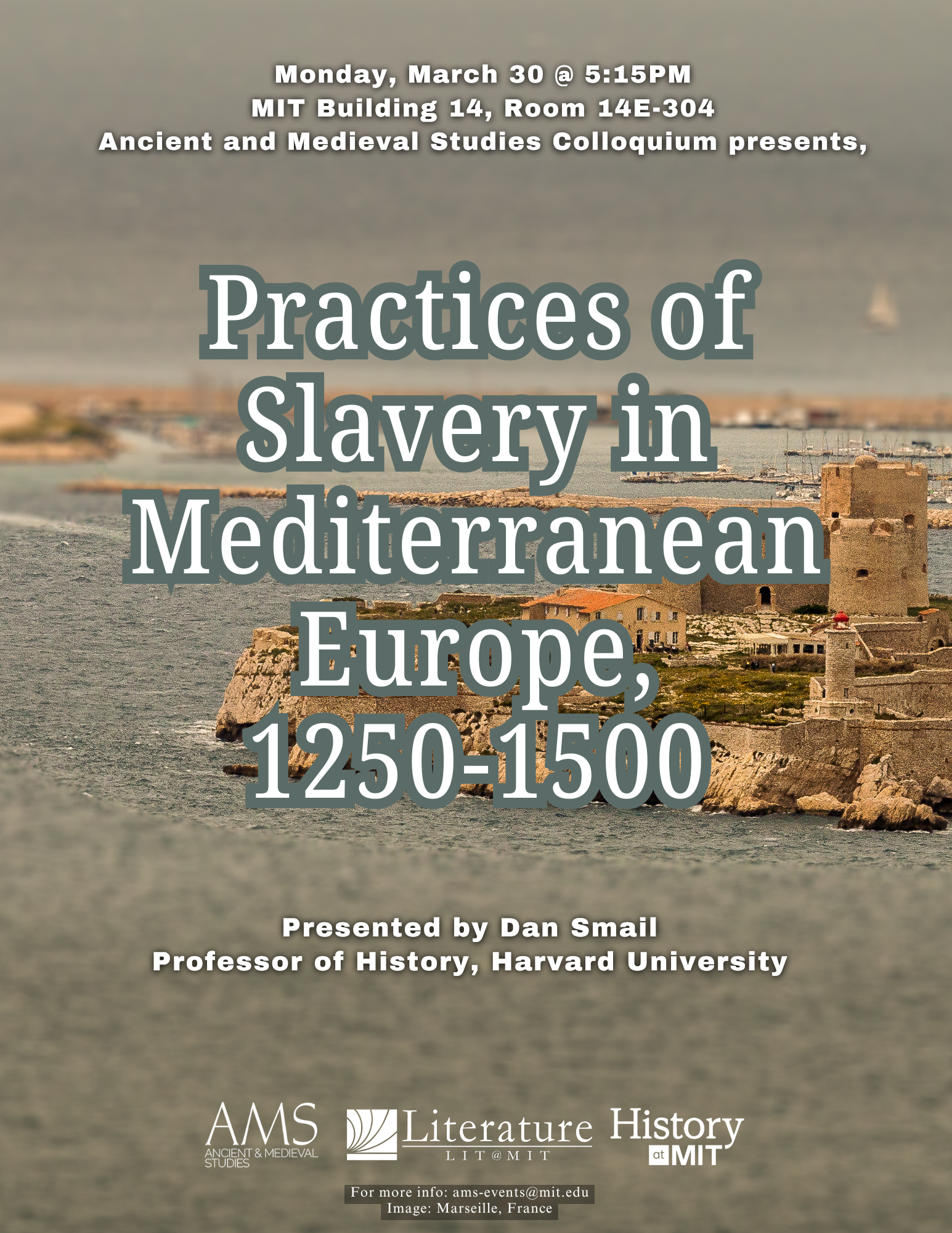
Ancient & Medieval Studies Colloquium presents, Dan Smail “Practices of Slavery in Mediterranean Europe, 1250-1500”
Presented by Daniel Smail Frank B. Baird Jr. Professor of History Harvard University Date: Monday, March 30 Location: Building 14, Room 14E-304 (map)* *Directions: From the Lewis Music Library stairs, take the third floor of Building 14, through the CMS/W doors. Alternatively, take the elevator to the 3rd floor, navigate to the opposite end of the 3rd floor hallway, and enter through the CMS/W doors. Abstract: Everywhere in late medieval Mediterranean Europe, it was possible, at least in theory, to purchase and hold an enslaved individual. The traffic in slaves began a noteworthy period of growth in the thirteenth century. In the second half of the fourteenth, the rise of the Black Sea trade led to a significant acceleration. Yet the practice of slavery was never uniform across the region. In some cities, as much as 15 percent of the population may have been enslaved. Elsewhere, the presence of enslaved individuals is scarcely detectable. The significant variation in the degree to which slavery implanted itself in the cities and towns of Mediterranean Europe is a historical phenomenon in search of explanation. Through a survey of practices of slavery in Marseille, a city located in the borderlands of the practice, this lecture seeks to frame […]
0 events,
2 events,
Global France Seminar presents, Deborah Jenson “During ‘Man’: Caribbean Philosophies of Cognition from Anténor Firmin to Sylvia Wynter”
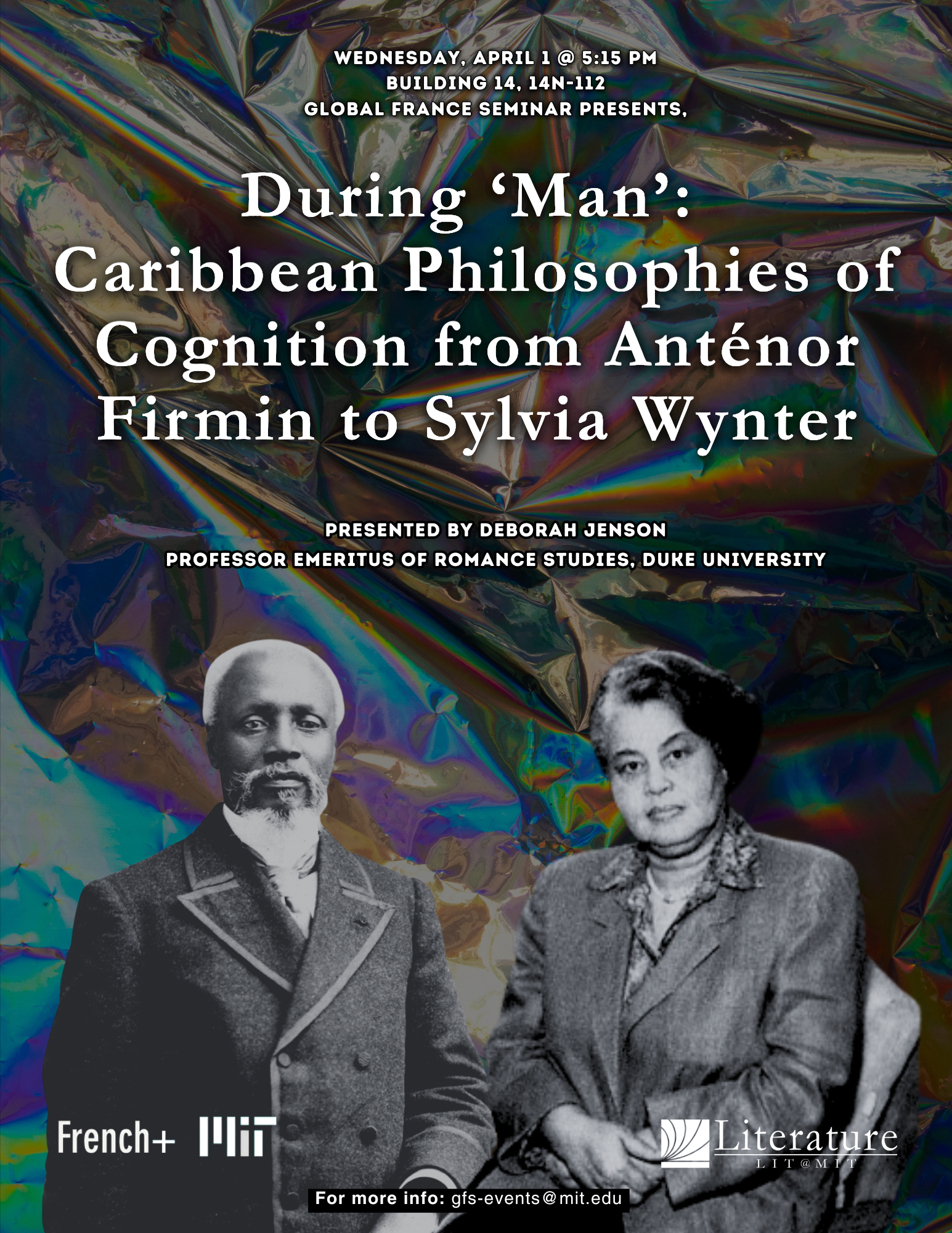
Global France Seminar presents, Deborah Jenson “During ‘Man’: Caribbean Philosophies of Cognition from Anténor Firmin to Sylvia Wynter”
Presented by Deborah Jenson Professor Emeritus of Romance Studies, Duke University Abstract: Sylvia Wynter defines a founding “Word of Man” representing man as a “selected being and natural organism” from 1512 onward. Around “Man,” Western Europe founded a tradition of secularized discourse heralding global expansion and plantation colonialism. “Man” for Wynter is an epoch as well as a figure, in whose name connections are forged between empirical scientific methodologies, liberal economies, and racialized identities of “Man-as-liber.” In this paper I present Wynter’s concept of the “autonomy of human cognition,” and of autopoiesis as biological cognition, in the context of a broader Caribbean and Latin American genealogy of freedom within the “Cognitive Charter” of modernity. From the responses of the Haitian thinker Anténor Firmin to the early brain science as presented at the Paris Anthropological Society where he was a member in 1883-84, to the development of cultural or ethno psychiatry in Haiti by Louis Mars, to Wynter’s integration of Chilean theoretical biology into her philosophy, I will present a Caribbean counter-model of cognition, not the Cartesian ego-model of rational consciousness, or what Vidal has called “brainhood,” but an environmental model of human being as praxis, in which, as Varela would later […]
A Reading with Poet Laureate Arthur Sze

A Reading with Poet Laureate Arthur Sze
Doors open at 5:30pm. Followed by book signing. Arthur Sze is a poet, translator, and editor, and in 2025 he was named the 25th Poet Laureate of the United States. He is the author of twelve books of poetry, including Into the Hush (2025) and The White Orchard: Selected Interviews, Essays, and Poems (2025); The Glass Constellation: New and Collected Poems (2021); Sight Lines (2019), for which he won the National Book Award; Compass Rose (2014); The Ginkgo Light (2009); Quipu (2005); The Redshifting Web: Poems 1970–1998 (1998); and Archipelago (1995). He also authored Transient Worlds: On Translating Poetry (forthcoming from Copper Canyon Press, 2026), The Silk Dragon II: Translations of Chinese Poetry (2024), and edited Chinese Writers on Writing (2010). His poetry has been translated into fifteen languages, including Chinese, Dutch, German, Portuguese, and Spanish. Sze received the 2025 Bollingen Prize for lifetime achievement in American poetry, the 2024 Rebekah Johnson Bobbitt National Prize for Poetry, 2024 National Book Foundation Science + Literature award, the Ruth Lilly Poetry Prize, the Shelley Memorial Award, the Jackson Poetry Prize, a Lannan Literary Award, and a Guggenheim Fellowship, among others. A chancellor emeritus of the Academy of American Poets and a fellow of the American Academy of Arts and Sciences, he was the 2023–2024 Mohr Visiting Poet at Stanford University. Professor emeritus at the Institute of American […]
0 events,
0 events,
0 events,
Literature Section
Massachusetts Institute of Technology
77 Massachusetts Avenue 14N-407
Cambridge, MA 02139
tel: (617) 253-3581
