

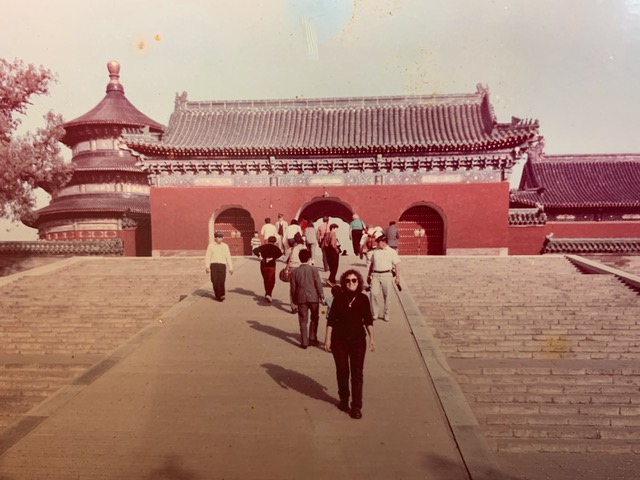
Ruth Perry at the Imperial Palace
In this Nov/Dec 2025 edition of the MIT Faculty newsletter (Vol. XXXVIII, No. 3), esteemed Ann Fetter Friedlaender Professor of Humanities and Emerita Professor Ruth Perry travels back to China in the late 1980s, “lecturing in six eastern cities: Beijing, Xuzhou, Hefei, Shanghai, Hangzhou, and Guilin.” She spoke to these academic institutions about women’s history and the history of feminism in America, feminist literary criticism, contemporary women’s writing, and women’s issues. A common language and love was found (in the American and Chinese women’s fight for rights) with a story about Ruth’s grandmother caring for her infant daughter at the picket line for International Ladies’ Garment Workers’ Union. Read more about her harrowing trail through narrow precipices, academic talks, and the unpredictable climate of feminism in China.
In the fall of 1987, released from teaching by a Guggenheim Fellowship and invited to China to lecture as an American feminist intellectual, I visited there for two months, lecturing in six eastern cities: Beijing, Xuzhou, Hefei, Shanghai, Hangzhou, and Guilin. I spoke about American women’s history and the history of feminism, feminist literary criticism, contemporary women’s writing (especially Black women’s writing), and women’s issues more generally, such as salary discrepancy, harassment, daycare, and eating disorders. This last issue shocked my Chinese audiences the most! Since I knew no Chinese, I prepared for my journey by reading every Chinese story and novel I could find that had been translated into English, so that I would have some common ground with my interlocutors. Many were my adventures in that large and various country.
I explored the imperial palaces in Beijing, discussing the “cultural revolution” with people who had lived through it, those who had suffered and a few who had met their partners in the countryside and remembered this traumatic period as a romantic and idealistic time[1]. I saw the beautiful gardens of Suzhou and the lovely Yangtse River in Guilin and also that city’s huge underground caverns, with great accretions pushing up from the floor and hanging from the ceilings, gigantic and creased and indented like brain tissue or lapped over like cloth from a giant’s bolt. I remember arguing about subjectivity with a poet in Guilin, who told me that the best poems were simply more accurate to the phenomena they described than lesser poems – and that what I attributed to “subjectivity” was merely a matter of inaccuracy. I remember trying to describe psychoanalytic criticism to another literary critic as we rowed a boat on the famous West Lake in Hangzhao, taking my examples from short stories I had read in translation. I climbed the famous Huang Chan, the Yellow Mountain, in Anhui province, terrified most of the way because the path was so steep and perilous, often just shallow footholds cut into the rock, without anything to hold onto. The worst moment came when crossing a narrow arch of stone without guardrails in a high wind with a sheer fall to certain death on either side.